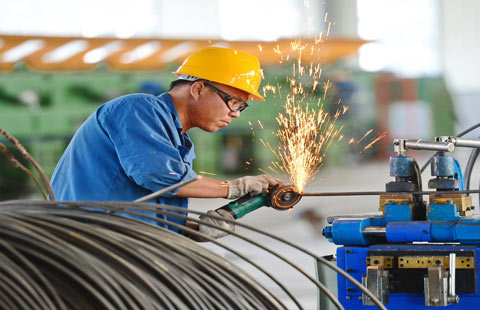
China's home appliance giant Midea eyeing 'smart factory' market
GUANGZHOU — Already a leader in air conditioners and washing machines, Chinese home appliance giant Midea has set its sights on a new industry: robots.
Midea made the announcement at a strategy conference Wednesday held in the southern Chinese city of Guangzhou, days after its acquisition of German robotics maker Kuka and Israeli motion control firm Servotronix.
Smart factory
In a livestream at the conference, Wang Xiaojin, head of the Guangzhou plant of Midea's air-conditioning division, showed a "smart factory" full of robotic arms and sensors.
"The factory can make and deliver products within 12 days of receiving an order, as well as track the order throughout the process," Wang said.
"Midea has invested 5 billion yuan ($725 million) in building smart factories in several Chinese cities using a total of 1,500 robots," said Gu Yanmin, vice president of Midea. "Our ultimate goal is to build more intelligent smart factories and use more robots in factories."
Midea is not alone in the automation drive. Other home appliance makers, including Haier, Gree and Galanz, are also building smart factories to enhance production and logistics speed.
"Kuka will help Midea grab more shares in the future robots market," Kuka CEO Till Reuter said at the conference.
"Servotronix will offer Midea the key technology in robots automation system," Servotronix CEO Ilan Cohen told dealers at the conference. "We have rich experience and Midea has a huge global market. There will be more industries looking forward to our cooperation."
In the past eight months, Midea has acquired 94.55 percent of Kuka and 50 percent of Servotronix.
Eyeing a big market
"China's home appliance industry is already highly competitive. But for the robot sector, it's quite the opposite," Gu said, explaining the strategy shift.
"In 2020, there will be 150 robots for every 10,000 workers in China, four times the level in 2015," Gu said, quoting projections by the International Federation of Robotics.
The 30-billion-yuan takeover of Kuka marks Midea's advance into the robotics business. Despite controversy, the takeover received the green light from regulators in Germany and the United States, and has become a model for Chinese overseas acquisitions.
"It's a standard commercial deal and the world will soon see the results of our cooperation," Gu said.
Reuter said Kuka, which now runs its second-largest assembly plant in Shanghai, wanted to expand its advantage in automotive robots to other sectors, while Midea hoped to explore new markets other than home appliances.
"Midea can open China's doors for us, and we can help Midea get more efficient production in China," Reuter said. "We have also new areas. It's a win-win for Kuka and Midea, and also a win-win for China and Germany."
"The two takeovers can help Midea build a complete industrial chain for upgrading traditional plants into smart factories and to sell models of smart factories to customers at home and abroad," Gu said.
"China's manufacturing sector, which is much bigger than that of Germany, offers unprecedented business opportunities for German robot makers," Reuter said.
China has the largest intelligent manufacturing and robot application market in the world. The government report from the ongoing annual session of China's national legislature called for speeding up the use of big data, cloud computing and the Internet of Things, and focusing on intelligent manufacturing.
"China's robot market is expected to maintain robust annual growth of 20 percent, far higher than the 5 to 10 percent growth in the United States and 14 percent growth in Europe," Reuter said.
Apart from the domestic market, Midea has also set its eyes on the huge global market. Gu said that some overseas customers were already in talks over Midea's automation solutions.
"The new business could be exported to other parts of the world and become a global industry leader like China's high-speed trains," Gu said. Enditem