Factors that set ICT giant apart
 |
|
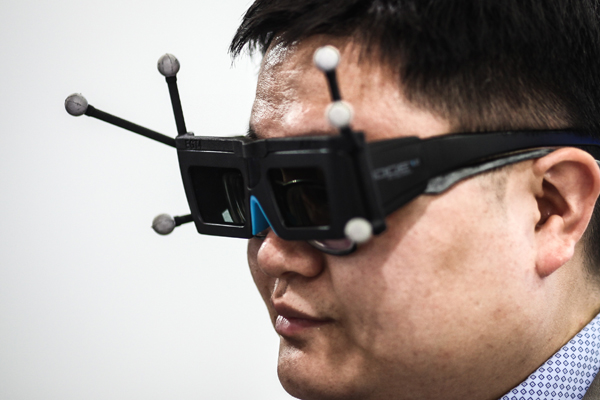
A visitor tests a virtual reality device at the Huawei Technologies Co's stand at an industrial expo in Hannover, Germany. [Photo/Xinhua] |
The products can address the challenges of the 4.5G and 5G era. As Zhang Jiayi, president of the company's antenna business unit, said at the forum: "Huawei focuses on satisfying the requirements of operators in the MBB (mobile broadband) era."
The ICT (information and communications technology) giant's achievements globally, particularly in Europe where giants Nokia and Ericsson used to hold sway, are noteworthy and a testimony to Laffont's "Theory of Competition in Telecommunications": industrial guidance and regulation can draw inspiration of any sort.
Compared with infrastructural sectors like highways and port construction, telecommunications is more demanding due to frequent technology renewals.
It also has a longer industrial chain than the petrochemical sector, even though the end consumers of both are very price-sensitive.
Intellectual property barriers are more commonly seen in telecommunications than other emerging sectors due to its long history and monopolies. So, studying Huawei's success in western Europe and its global strategy, not just its high-tech projects, would yield useful lessons.
Leading innovative companies in China have become a major focus within the IT industry. The country is looking forward to exporting a greater number of high-tech products and sharpening its competitiveness. So, the responsibility of going global has fallen upon firms like Huawei, as China shifts its economy toward technology and innovation.
Strategy-wise, Huawei's global development is about not just corporate or sectoral growth but innovation. In addition to its Chinese roots, Huawei also has to thank its management's right calls, their openness and doggedness as well as its employees' hardwork.
More than a decade back, Huawei was facing pressing challenges and had to struggle for survival. Its path toward globalization has enabled China to learn tremendously.
Huawei has been following three strategies: focus, integration and openness. Xu Wenwei, Huawei's chief strategy and marketing officer as well as head of its European operations, said several times that the company has adopted a partnership strategy in Europe.
Besides teaming up with SAP and Imperial College London, Huawei works with partners including Alstom and British Telecom, as it seeks to improve its products and services and introduce additional value.
Listening to clients' demands carefully and joining with partners gave Huawei success in Europe, as Xu said. And that's the way it will retain its technological edge.
The company actively fulfils its social responsibilities and integrates into local society wherever it operates, unlike some Chinese firms that are sometimes seen overseas as being interested only in projects that can generate "fast money".
Intangible assets, including brand recognition and corporate reputation, should be given the highest priority. Chinese peers have a lot to learn from Huawei in this respect.
Huawei has climbed from 88 to 72 on Interbrand's 2016 Best Global Brands ranking, making it one of the fastest risers in the technology sector.
Its brand value increased 18 percent year-on-year to $5.84 billion, a result of brand building. Brand recognition can bring value in a real sense, as companies will have more room in pricing, and it also serves as protection in times of crisis.
Reputation and brand are intertwined. A good reputation is the basis for a good brand, while a good brand can bring good reputation. Huawei's knowledge of how to cultivate its reputation is one of the reasons for its worldwide recognition. The biggest distinction setting Huawei apart from its peers is how it lives out its globalization strategy.
The writer is director of the Experts Committee at the State Information Center in Beijing.