 |
|
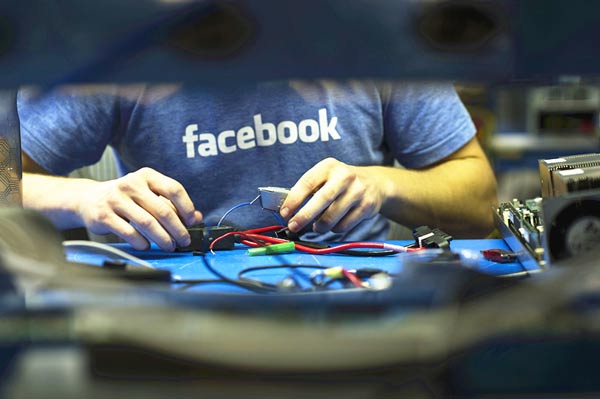
Derek Jouppi, a hardware design engineer intern at Facebook Inc, tests servers at the company's hardware labs in Menlo Park, California, US. [Photo/Agencies] |
In a sign of broader ambitions, Facebook opens hardware lab
Facebook built its fortune on the internet, that non-physical space where people share updates and digital videos with friends. But deep inside its Silicon Valley headquarters, engineers have stocked a new lab with computerized lathes, industrial mills and tools for making physical goods.
It's not a factory for mass-producing smartphones or other consumer products. Rather, it's where engineers will be working on some of the high-tech gadgetry needed for the company's long-term plans to connect people through smart devices, virtual-reality headsets and high-flying drones that deliver internet signals via laser to remote parts of the world.
And like Google's celebrated X lab, where the internet search giant pursues "moonshot" projects such as self-driving cars, Facebook's new research facility demonstrates that in Silicon Valley, leading tech companies are rarely content to keep doing the same thing.
"When you think about connecting the world, you have to build different types of hardware to help people connect," said Jay Parikh, Facebook's head of engineering and infrastructure.
To get virtual reality right, he added, Facebook needs to refine hardware such as lenses and processors.
The lab will be a space for engineers to design energy-efficient servers for Facebook data centers, test new laser mounts and drone propellers and perfect a prototype 360-degree video camera that Facebook unveiled at a conference in April.
Facebook announced the lab's opening Wednesday and invited journalists to tour it. The company wouldn't say how much it spent to build the facility.
The lab is dubbed Area 404, a joke playing off the "error 404" message internet users see when they try to visit a web page that can't be found. Facebook says its engineers had long talked about wanting such a workspace, but it couldn't be found because it didn't exist until now.
Facebook became a Silicon Valley powerhouse and Wall Street darling because its vast online network is a mecca for digital advertisers. The company sold more than $6 billion worth of ads in the April-June quarter, reaping more than $2 billion in profit.
That offers plenty of leeway to invest in new ventures. Two years ago, the company spent $2 billion to buy Oculus VR, a startup that makes high-end gear for virtual reality. Facebook CEO Mark Zuckerberg has predicted that virtual reality will be a leading platform for communication, entertainment, education and business in the future. In recent speeches, he outlined a 10-year vision for Facebook that includes services based on virtual reality, artificial intelligence and internet access for the world's most under-developed regions.
The Oculus operation has its own lab in Seattle, while Facebook's drone team is based in Somerset, England. They aren't relocating, but Parikh said engineers from both groups will also use the new facility.
Zuckerberg has hinted at other aspirations, too. This spring, he announced the formation of a mysterious research-and-development group known as "Building 8." It's led by prominent engineer Regina Dugan, a former director of the Pentagon's Defense Advanced Research Projects Agency, or DARPA, the agency that created the internet in the late 1960s.
Before joining Facebook, Dugan ran a Google team that specialized in "rapid innovation" of new tech gadgets. Her projects included a location-tracking smartphone camera for creating 3-D virtual worlds, a technology that Lenovo will include in the Phab2 Pro out this month .
Dugan's group will use the Area 404 lab, but Facebook wouldn't talk about specific projects she will undertake.
Analysts say it's too early to know if these ideas are "vanity projects" or if they will boost Facebook's bottom line. But rivals including Google, Amazon and Microsoft have similar ambitions, some involving drones, tablets or other hardware. Facebook says it spent $4.8 billion on research and development in 2015, nearly doubling its budget from the previous year.
"When you're big enough, you need to think bigger picture and longer term," said Bob O'Donnell, chief analyst at Technalysis Research.
Facebook could wait for others to develop new gadgets, he said, but the company can learn by designing hardware on its own and seeing how its software works with it. He said Facebook could even license its hardware ideas for others to manufacture.
Aside from Oculus, most of Facebook's hardware isn't aimed at the consumer market. Several years ago, the tech industry was abuzz with rumors that Zuckerberg wanted to build a Facebook smartphone. That never happened, although Facebook created special software for an HTC phone that didn't sell well.
Instead, Facebook has led an industry effort to develop more energy-efficient computer centers by sharing server designs with other companies. Similarly, Facebook says it developed the 360-degree video camera to show other inventors what's possible in new camera designs. Those designs could, in turn, produce more video content for the social network to share.
Facebook executives say their solar-powered drones are also meant as prototypes, in the hope that telecommunications companies will use their designs. While Zuckerberg says internet access can spur economic development in poor nations, Facebook also stands to benefit if more people get online.
Associated Press?


Copyright 1995 - . All rights reserved. The content (including but not limited to text, photo, multimedia information, etc) published in this site belongs to China Daily Information Co (CDIC). Without written authorization from CDIC, such content shall not be republished or used in any form. Note: Browsers with 1024*768 or higher resolution are suggested for this site.
License for publishing multimedia online 0108263 Registration Number: 130349