 |
|
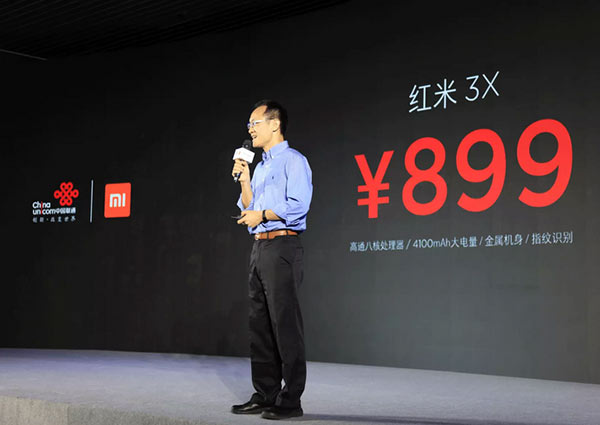
The?Redmi 3X will go on sale for 899 yuan ($136) through China Unicom's offline stores.[Photo provided to chinadaily.com.cn] |
The move came as the country's online smartphone sales has hit a ceiling and as Xiaomi grapples with declining shipments and mounting competition from rivals such as Oppo Electronics Corp.
Xiaomi launched a custom-made smartphone Redmi 3X on Wednesday. Equipped with a large battery and a 13-megapixel rear-camera, the new phone will go on sale for 899 yuan ($136) through China Unicom's 30,000 offline stores and more than 230,000 bricks-and-mortar retailing partners.
Lei Jun, CEO and founder of Xiaomi, said so far more than two-thirds of the company's smartphones have been sold through e-commerce platforms and the company's official website.
"The proportion of online sales is too big," Lei said. "To maintain the rapid growth we have seen in the past four years, expanding offline retailing channels becomes the key."
Xiaomi and China Unicom will also expand their cooperation beyond handsets to a wide range of products, such as Xiaomi TV, routers and air purifiers.
"All of these Xiaomi electronic products will be available at our nationwide offline retail stores," said Xiong Yu, deputy general manager at China Unicom.
The move fits into China Unicom's broad efforts to transform its abundant bricks-and-mortar assets into a big retailing platform of various electronic products, Xiong added.
As China's smartphone market is reaching saturation point, a number of vendors are banking on bricks-and-mortar retailers to spur their growth.
Xiaomi said earlier this year it will open 200 to 300 retail stores to bolster sales. Its major rival Lenovo Group Ltd also pledged more efforts to expand its offline retailing presence, which its senior Vice-President Chen Xudong called the key to surviving intense competition.
CK Lu, principal analyst at consulting firm Gartner Inc, said China Unicom's sprawling offline resources gave Xiaomi a ticket to enter into low-tier cities, which are dominated by its rivals Oppo Electronics Corp and vivo Mobile Communication Technology Co Ltd.
In the first quarter of this year, Oppo and vivo made their way into the world's top-five ranking of smartphone vendors for the first time, pushing out Xiaomi and Lenovo.
"Xiaomi is an expert in online marketing, but lacks experience and talent to run offline stores. So it makes tons of sense to partner with China Unicom," Lu said.
According to Counterpoint Technology Market Research, telecom operators' retail channels account for 30 percent of China's total smartphone sales, while e-commerce sites contribute another 30 percent, with the rest managed by professional electronic retail stores.
James Yan, a Beijing-based analyst at Counterpoint, said partnering with China Unicom will help Xiaomi quickly boost smartphone sales, but won't necessarily deliver good profits.


Copyright 1995 - . All rights reserved. The content (including but not limited to text, photo, multimedia information, etc) published in this site belongs to China Daily Information Co (CDIC). Without written authorization from CDIC, such content shall not be republished or used in any form. Note: Browsers with 1024*768 or higher resolution are suggested for this site.
License for publishing multimedia online 0108263 Registration Number: 130349