The future development of the Chinese economy will focus on improving productivity, and applying "Internet Plus" approach to create new market growth and drive innovation.
Peter Tyroller, a board member at Robert Bosch GmbH in Germany and responsible for Asia Pacific, said China's fast growing 4G network would build a solid foundation for its manufacturers. This in turn would benefit greener, more efficient and sustainable development.
"With the advent of Industry 4.0, launched in Germany in 2013, we will see new players-especially from the Internet world-entering the manufacturing sector, where they will change customer-supplier relationship in both China and Germany," Tyroller said.
Indeed, manufacturing will be a key factor in determining competitiveness. Many countries have identified digital, intelligent and green sectors in the drive to develop high-end manufacturing.
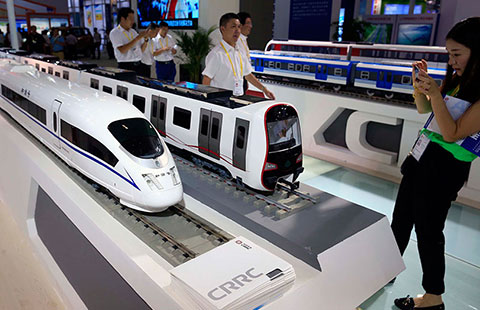
China has been implementing a plan titled "Made in China 2025", aiming to enhance the country's manufacturing capacity under the guidance of technological progress, knowledge-based transformation and green development. This will help the Chinese economy grow at a faster speed.
Other developed nations are also paying attention to re-industrialization and re-manufacturing plans. These include the Advanced Manufacturing Partnership Program unveiled by the United States government in 2011, and Factory 2050 launched by the European Regional Development Fund and the United Kingdom government in 2013.
"Connected industrial operations will consume less energy, since they are organized to optimize machine usage, labor, and product and service delivery," Tyroller said. "Large Chinese manufacturers are already in an upgrading boom, while small and medium-sized companies also have the chance to benefit from this transformation."
He said to achieve these goals, advanced software and Internet applications in the field of big data analysis have to be established, so that all parts of the value chain can communicate with each other.
The German tech and service supplier wants to introduce Industry 4.0 solutions into its China manufacturing facilities step by step. It is now running a number of pilot projects in its automotive electronics plant in Suzhou, Jiangsu province.
The sensor-testing center Bosch established there was designed according to the concept of Industry 4.0. Once it has been fully installed, it is expected that the whole project will save around 6 million yuan ($970,000) a year.
Chen Yudong, president of Bosch China, said such a major shift in manufacturing philosophy will affect global industry for years to come, and China will not be immune to this development.
"Industry 4.0 will lead to improvement in productivity and resources efficiency, but its potential benefits are even greater if it is extended to include all stages of the value chain-suppliers, manufacturers, and customers, as well as international manufacturing networks," Chen said.
Higher productivity will allow higher wages and may help alleviate labor shortages. In 2014, China's working-age population-defined as those between 16 and 60 years old-fell by 3.7 million to 916 million. This was the third consecutive year it declined since 2012, according to the National Bureau of Statistics.
Between 2010 and 2050, China's work force as a share of the population will probably shrink from 72 percent to 61 percent. Therefore, connected industrial operations will change the qualification profiles needed in manufacturing in the country. Obviously, the demand for engineering and IT skills will increase.
Zhao Ying, a researcher at the Beijing-based Institute of Industrial Economics of the Chinese Academy of Social Sciences, said as both Made in China 2025 and Industry 4.0 will put pressure on less qualified employees, they may have to find new opportunities in other sectors, such as services and agriculture. "These shifts will lead to new business models, which will partly substitute old ones. In this context, Industry 4.0 will drive a profound transformation in the country, and present a major challenge," said Zhao.

Copyright 1995 - . All rights reserved. The content (including but not limited to text, photo, multimedia information, etc) published in this site belongs to China Daily Information Co (CDIC). Without written authorization from CDIC, such content shall not be republished or used in any form. Note: Browsers with 1024*768 or higher resolution are suggested for this site.
License for publishing multimedia online 0108263 Registration Number: 130349