 |
|
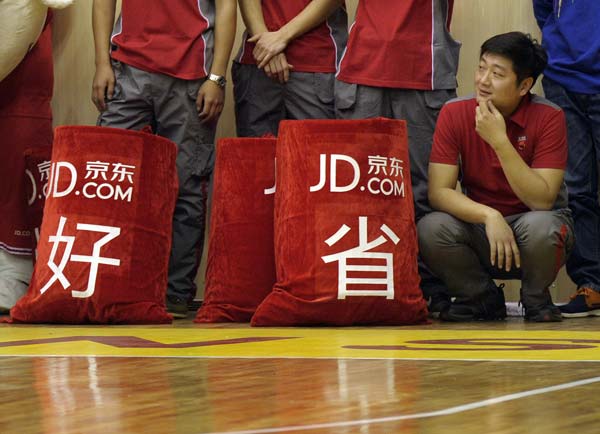
JD.com workers take part in a recent promotional event. [provided to china daily] |
"It's complicated serving so many SMEs, but Alibaba has done it successfully in China. It's no surprise Ma wants to copy the model in the US now it's been listed," he added, referring to the company's listing on the New York Stock Exchange last year.
Taobao vendors are required to run their own stores: They upload photos and product descriptions, handle packing and shipping, and manage after-sales services. Like eBay, a user's reputation is enhanced-or completely destroyed-by ratings and comments left by customers.
In China, people today even use "taobao" when they mean to say online shopping.
"Alibaba is the unquestionable leader in online shopping in China," said Teng Bingsheng, an associate professor of strategic management at the Cheung Kong Graduate School of Business. "This is a big advantage when attempting to get US companies to believe they can have a bigger chance of success in the Chinese market than through similar platforms."
Last year, transactions on Alibaba's e-commerce platforms totaled $161 billion, far more than the $77.6 billion reported by Amazon.
Meanwhile, data released by New York consultants Forrester Research showed Tmall and JD.com are dominating China's e-commerce market. Tmall holds a 57-percent share of the business-to-consumer market, while JD.com holds 21 percent.
Different expectations
There is no denying the lure of China's e-commerce market. China will become the largest market for buying and selling products online across international borders by 2020, according to a report by Alibaba and global consultancy Accenture.
The value of products sold by online retailers to overseas consumers will reach nearly $1 trillion by 2020, with China the driving force for growth, the report said.
Yet some analysts are skeptical about the ability of US SMEs to use Chinese e-commerce platforms, citing the tough competition and barriers of entry. They suggest that small retailers may also not be equipped to deal with a customer base with differing shopping expectations.
"The smaller companies-and this is not an Alibaba point, it's not a China point-h(huán)ave very limited ability to manage any major undertaking," said Frank Lavin, founder and CEO of Export Now in Akron, Ohio, which advises businesses accessing China's e-commerce platforms. "If you're only a $5 million company, the entire management team is one or two people. You're asking them to work with a series of somewhat complicated issues on foreign exchange, remittance, and logistics. They just don't have the management team to do that."
Lavin, who served as undersecretary of commerce during the George W. Bush administration, said China is the easiest market for US companies to enter, but they still need capability and capacity, while smaller companies-in the $1 million to $10 million range-will have difficulty.
To get an online store up and running on Alibaba, an overseas company would need to design and build a Chinese-language website, pay a deposit to Alibaba, and pay for trademark registration, which could cost $50,000 to $100,000, he said. To advertise their brands and services, companies may need to spend another $100,000 to $200,000.

Copyright 1995 - . All rights reserved. The content (including but not limited to text, photo, multimedia information, etc) published in this site belongs to China Daily Information Co (CDIC). Without written authorization from CDIC, such content shall not be republished or used in any form. Note: Browsers with 1024*768 or higher resolution are suggested for this site.
License for publishing multimedia online 0108263 Registration Number: 130349