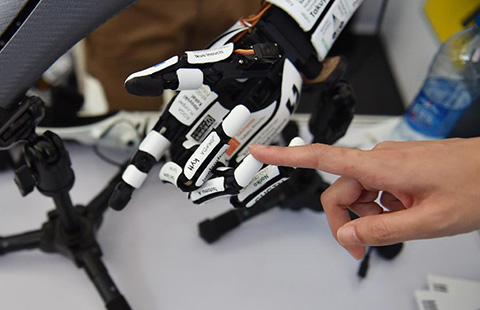
Rising labor costs and cutthroat competition are forcing the garment industry in Dongguan to invest in robotic technology to increase the bottom line.
High-tech machines from Germany, Italy, the United States and Japan have been installed, along with Chinese lines, as clothing companies struggle to recruit unskilled staff in the battle against cheaper rivals from Vietnam, Cambodia and Bangladesh.
Located in South China's Guangdong province, Dongguan is known as the capital of China's garment industry. Last year, the city's 520 manufacturers exported $7.5 billion worth of apparel products and fashion accessories, according to Huangpu Customs. This was a rise of 3.8 percent compared to 2013, but a far cry from 2008 when the city shipped goods worth $113 billion. In a bid to retain global market share, investment has increased and even skilled staff have been trimmed.
"High-end garment machines have become popular with factory owners as they reduce spending on training skilled workers," Chen Yaohua, chairman of Dongguan Association of Textile and Garment Industry, said. "Most of the factories in Dongguan have installed cloth-making machines imported from Germany, Italy, the US and Japan along with homegrown technology."
Even so, there are still more than 13,600 unskilled job vacancies in the sector, Li Ganqiu, spokesman for the Dongguan Economic Development, Science and Information Technology Bureau, pointed out.
"Although nearly all the garment factories in the city are equipped with different types of machines and levels of technology, many are still short of hands," Li said.
Wages have also become a problem. The average monthly salary of a garment worker soared to about 3,200 yuan ($516) in March, a 12 percent increase compared to the same period last year.
Part of the reason for the increase is that factory owners need to pay employees more for working extra shifts. This comes at a time when cheaper fashion products are rolling off the production lines in India, Pakistan, Vietnam, Cambodia and Bangladesh.
To combat mounting competition, the industry, which is labor-intensive, has turned to technology. Garment-making machines can be operated by fewer workers and this can cut costs by more than 30 percent as well as boosting productivity by 40 percent.
"By introducing this robotic technology in different workshops, a medium-sized factory can bring down its workforce from 1,200 to 800," Chen said. "They can also help prevent material waste and increase manufacturing accuracy."
Although this rush to bring in technology will not completely automate factories, the number of workers needed will be reduced as garment companies look at new ways to survive in a changing business landscape.
The switch will also help address the chronic labor shortage in the industry as China moves to more upmarket manufacturing. "In Dongguan, the shortage of workers in the garment sector could last for another decade," Yu Changyan, managing director of Huifeng Industry Co in Humen, Dongguan, said. "So, we are dependent on automation to make stable profits."

Copyright 1995 - . All rights reserved. The content (including but not limited to text, photo, multimedia information, etc) published in this site belongs to China Daily Information Co (CDIC). Without written authorization from CDIC, such content shall not be republished or used in any form. Note: Browsers with 1024*768 or higher resolution are suggested for this site.
License for publishing multimedia online 0108263 Registration Number: 130349