 |
|
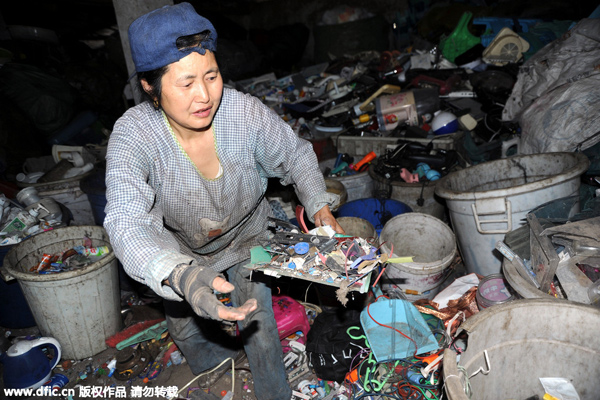
A woman sorts out electronic waste at a rubbish recycle?center in Chongqing, April 1, 2015. [Photo/IC] |
Overall, 41.8 million tons of "e-waste" – defined as any device with an electric cord or battery – were dumped around the globe in 2014 and only an estimated 6.5 million tons were taken for recycling, the United Nations University (UNU) said.
"Worldwide, e-waste constitutes a valuable 'urban mine', a large potential reservoir of recyclable materials," said David Malone, the UN under-secretary-general and rector of UNU.
The report estimated that the discarded materials, including gold, silver, iron and copper, was worth some $52 billion.
The United States led e-waste dumping with 7.1 million tonnes in 2014, ahead of China on 6.0 million and followed by Japan, Germany and India, it said.
The United States, where individual states run e-waste laws, reported collection of 1 million tons for 2012 while China said it collected 1.3 million tons of equipment such as TVs, refrigerators and laptops in 2013.
Norway led per capita waste generation, with 28 kg (62 lbs) dumped per inhabitant, followed by Switzerland, Iceland, Denmark and Britain. On that ranking, the United States was ninth and China was not among a list of the top 40.
Researchers said that in many case it made economic sense to recover metals that included 16.5 million tons of iron, 1.9 million tons of copper as well as 300 tons of gold.
The gold alone was valued at $11.2 billion, with the precious metal used in devices because it is a good, non-corrosive conductor of electricity.
"At the same time, the hazardous content of e-waste constitute a 'toxic mine' that must be managed with extreme care," said Malone, referring to components such as lead and mercury which are found on some discarded devices.
Global volumes of e-waste were likely to rise by more than 20 percent to 50 million tonnes in 2018, driven by rising sales and shorter lifetimes of electronic equipment, the report said.
Ruediger Kuehr, one of the authors of the report, said many people were aware of the global problem of waste but often left ageing toys or cellphones in drawers or cellars at home. "People don't see it as an issue in their own households," he said.

Copyright 1995 - . All rights reserved. The content (including but not limited to text, photo, multimedia information, etc) published in this site belongs to China Daily Information Co (CDIC). Without written authorization from CDIC, such content shall not be republished or used in any form. Note: Browsers with 1024*768 or higher resolution are suggested for this site.
License for publishing multimedia online 0108263 Registration Number: 130349