Related story: Will Chinese love Apple Pay as much as iPhone? By Xinhua News Agency
 |
|
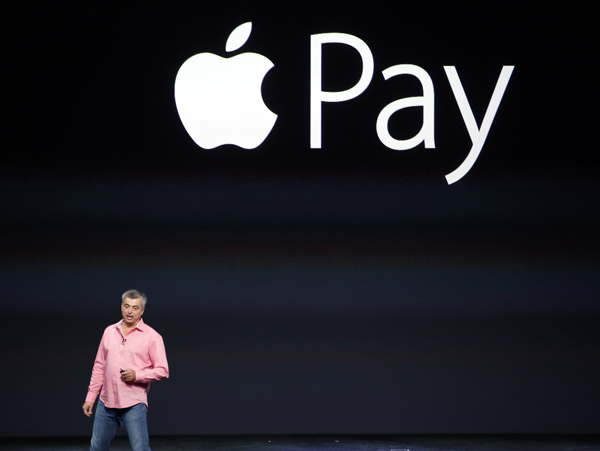
Eddy Cue, Apple's senior vice president of Internet Software and Service, introduces Apple Pay during an Apple event at the Flint Center in Cupertino, California, September 9, 2014. [Photo/Agencies] |
While Apple has yet to announce a time table for the launch of its payment service in China, analysts are already speculating whether Apple Pay can capture a sizable share of China's booming mobile payment market.
Mobile payment in China has seen explosive growth over the past two years, reaching 5.99 trillion yuan (982.3 billion US dollars) in 2014, according to IT consultancy iResearch.
But the boom in mobile payment, as reflected by a 391.3 percent year-on-year growth in 2014 and 707 percent in 2013, has been driven mostly by domestic internet giants Alibaba and Tencent, with a combined market share reaching 93.4 percent last year, data from iResearch shows.
Aside from domestic dominance, Apple Pay must also contend with limited consumer use of their payment technology.
Apple Pay employs Near Field Communication (NFC) technology, which allows people to tap their iPhones on a point of sale (POS) machine to complete transactions at brick-and-mortar businesses.
China Union Pay (CUP), China's bank card association, has worked with the country's three major telecom operators for years to promote NFC payment for mobile phones, only to find NFC payment accounting for a meager 1.6 percent of the total mobile payment market in 2013.
Analysts say the marginal share of NFC payment will limit Apple Pay's potential to grow in China. By 2018, NFC payment is only estimated to take up six percent of total mobile transactions worldwide, while the rest will use software-based services, such as Quick Response (QR) codes, according to technology research company Gartner.
"You would expect NFC payment's share in China to be higher than the global average by then, but not much," says Sandy Shen, research director for consumer services and mobile devices at Gartner.
At the same time, the Chinese mobile payment market, which iResearch expects to triple to 18 trillion yuan in 2018, is far too big to ignore.
During a briefing on consumer technology by Gartner in Beijing on Friday, Shen asked a packed conference room whether any of them substitute their smartphones for cash or credit card when making a purchase. Only a few raised their hands.
"I was glad to see a show of hands, though very few," Shen said. "I got nothing from the audience when the same question was asked in Taiwan."
While NFC has yet to gain huge traction in China, the race to capture a slice of the country's 520 million smart phone users continues to grow more heated.
Over the past two years, the tug-of-war between Alibaba and Tencent has extended from online payment to offline, as the rivals enter a race to team with stores, taxi-hailing apps and other merchants to allow their users to pay using QR codes.
Alipay, the escrow service from e-commerce firm Alibaba, accounted for 82.8 percent of mobile payments in China last year. Another 10.6 percent went to Tenpay, the payment arm of instant messaging and gaming giant Tencent, statistics from iResearch show.
Alipay also offers users the option to pay via NFC, but QR codes have proved far more popular so far.

Copyright 1995 - . All rights reserved. The content (including but not limited to text, photo, multimedia information, etc) published in this site belongs to China Daily Information Co (CDIC). Without written authorization from CDIC, such content shall not be republished or used in any form. Note: Browsers with 1024*768 or higher resolution are suggested for this site.
License for publishing multimedia online 0108263 Registration Number: 130349