 |
|
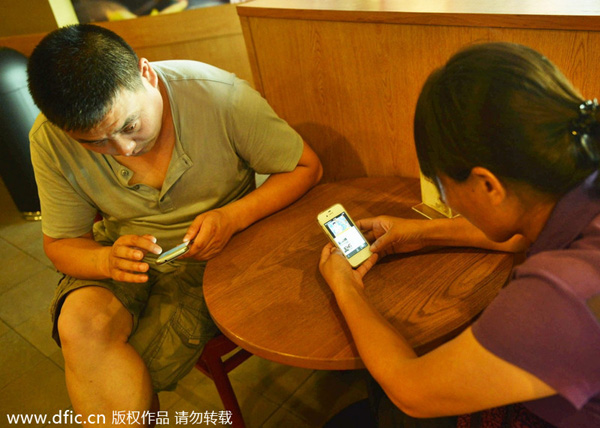
Photo taken on July 21, 2014, shows two mobile Internet users browse online in Hangzhou, Zhejiang province. [Photo/IC] |
BEIJING - Everybody knows that iPhone is a product of Apple, but not many people would think there was a relationship between the boom of mobile phones in China and its fundamental political system.
However, there would be nowhere near as many as the current 1.29 billion mobile phones being used in China without the National People's Congress (NPC), the top legislature whose annual session is scheduled to close Sunday.
Just a few decades ago, few people could imagine that everyone in their family would own a mobile phone.
Things began to change in 1979, when the NPC passed the Law on Chinese-Foreign Equity Joint Ventures, which was followed by the Law on Foreign-Capital Enterprises in 1986. The two laws made it possible for foreign companies to invest in what had been a closed country.
At that time, controversies remained on whether the socialist China should make laws to protect foreign enterprises from capitalist economies.
But after the laws were made, the question was not whether but how to protect foreign investment in China.
Motorola set up its Beijing office in 1987, and its company in Tianjin in 1992, backed by an investment of $120 million.
The next turning point was to be 1992, when China established itself as a "socialist market economy" and adopted this into the Constitution.
Since then, the NPC and its Standing Committee have enacted and revised more laws to better suit social and economic development, including the Civil Law, Property Law, Law on the Protection of Consumer Rights, Advertising Law and Anti-monopoly Law.
"If we look at research, development, production, sales, after-sales and content, a mobile phone is related to nearly all the current laws in China," said Liang Ying, director of the research office under the legislative affairs commission of the NPC Standing Committee.
Lawmakers are mulling harsher punishment for non-accessible downloaded content and the sharing of customers information.

Copyright 1995 - . All rights reserved. The content (including but not limited to text, photo, multimedia information, etc) published in this site belongs to China Daily Information Co (CDIC). Without written authorization from CDIC, such content shall not be republished or used in any form. Note: Browsers with 1024*768 or higher resolution are suggested for this site.
License for publishing multimedia online 0108263 Registration Number: 130349