 |
|
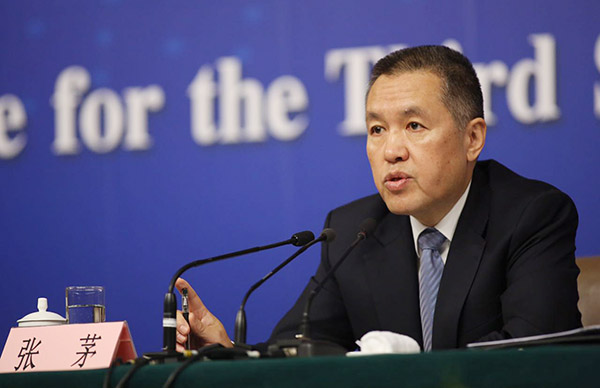
Zhang Mao, head of the State Administration for Industry and Commerce, speaks at a press conference in Beijing, March 9, 2015. [Photo by Wang Jing/China Daily] |
The key to tackling fake goods sold online is to establish a system that will record those who break the rules, said a top commercial regulator in Beijing on Monday.
Zhang Mao, head of the State Administration for Industry and Commerce, told reporters during the ongoing two sessions that it is important to "name and shame" those who sell counterfeit products online.
"If they sell fake goods, their behavior will be recorded in a credit system, which will affect their business, whether it means applying for a license or getting a bank loan," he said.
He did not give details on the timing of setting up such a system, but said that selling fake goods online has become "a major challenge" to an orderly market.
Zhang's comments came in response to a question regarding the sales of fake goods on the e-commerce platforms of Alibaba Group Holding Ltd.
Alibaba and the SAIC engaged in an unusual public dispute in January over a quality-check report, which said that less than 40 percent of the goods tested that were sold on Taobao, one of Alibaba's online shopping sites, were authentic.
Zhang said that China's e-commerce boom was a new challenge for regulators. "Issues such as ... fake goods and the difficulty in getting refunds for purchases have become the top complaints of online shoppers," he said.
Although the government and e-commerce sites have made a lot of effort, fake goods will not go away easily. Zhang said his administration will do more by pushing the drafting of China's e-commerce law.
"Innovation is necessary when it comes to supervising and monitoring the online market," he said, adding that big data technology can be used to analyze the online behavior of companies and to see if they follow the rules.
Wang Xiaoxing, an analyst with Analysys International, a Beijing-based Internet consultancy, said that fighting fake goods online requires further cooperation between the government and e-commerce companies.
"Government organizations may not have a deep understanding of how online marketplaces work. Setting up a mechanism to encourage e-commerce companies to share their information and expertise with the government is key," he said.
According to the SAIC, e-commerce transactions accounted for about 10 percent of retail sales last year, passing that mark for the first time. The market is growing at 30 percent to 40 percent annually, it said.

Copyright 1995 - . All rights reserved. The content (including but not limited to text, photo, multimedia information, etc) published in this site belongs to China Daily Information Co (CDIC). Without written authorization from CDIC, such content shall not be republished or used in any form. Note: Browsers with 1024*768 or higher resolution are suggested for this site.
License for publishing multimedia online 0108263 Registration Number: 130349