Designing phones to suit older hands
|
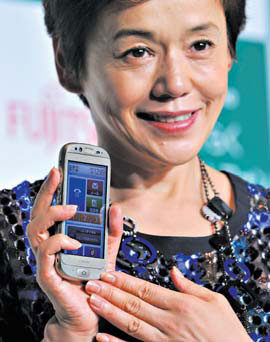
Shinobu Otake, an actress, is marketing a smartphone aimed at an aging demographic.?[Photo / Agencies] |
TOKYO - The Japanese electronics industry largely missed out on the smartphone revolution. Yet this summer, even as one Japanese company, NEC, exited the business, another one, Fujitsu, announced plans for a new export push.
Instead of competing with Samsung and Apple in the mainstream market, Fujitsu is aiming at older consumers, who, the company says, are not always served adequately by Apple's iPhone or the Samsung Galaxy series.
In partnership with Orange, formerly France Telecom, Fujitsu has started selling a smartphone in France that uses a technology called Raku-Raku, or "easy easy."
The handset has a touch screen and provides Internet access, but it has larger buttons and other features aimed at older people who may struggle with conventional smartphones.
"We believe the smartphone provides benefits to these customers," said Toru Mizumoto, the director of the mobile product division at Fujitsu.
In partnership with NTT DoCoMo, the leading mobile network operator in Japan, Fujitsu has sold 20 million Raku-Raku phones in Japan since it introduced them in 2001. Ten million of them remain in active use.
While most of these phones are old-fashioned feature phones, Fujitsu and DoCoMo introduced the first Raku-Raku smartphone in Japan last year.
Japanese manufacturers tend to focus on the domestic market, introducing features that are considered innovative here but considered quirky and less appealing elsewhere.
Aging consumers may be a niche market, but they present a growing opportunity in most industrialized countries. In Japan, 39 percent of the population will be 65 or older in 2050, up from 23 percent in 2010, according to the Statistics Bureau of Japan.
In France, those 65 and older will make up 25 percent of the population in 2050, up from 17 percent in 2010, data from the United Nations show.
"If you're a smaller vendor and maybe haven't had much of a presence in Europe, it makes sense to look at these kinds of niches," said Andre Malm, an analyst in Sweden. "It's an underserved market."
Orange and Fujitsu say they view the partnership in France as a pilot project; if the phone catches on, they say, it will also be offered in other European markets in which Orange operates, like Britain.
"For Japanese vendors, it has been challenging to go abroad," said Michito Kimura, an analyst, "but this technology does meet a demand."
As the 65-and-up population is growing, it is also becoming younger - at least in its affinity for technology. Those who will retire in 2020 or 2030 are active on Facebook or Twitter now.
"We see that there is a big, big part of the senior population that is willing to go for a smartphone," said Augustin Becquet, the head of Orange's device portfolio.
Still, physical dexterity may deteriorate with age, as it has with past generations. That is where the Raku-Raku smartphone, called the Fujitsu Stylistic S01, comes in.
At first glance, the S01 looks like a fairly ordinary smartphone. The features aimed at pleasing old people could just as easily be annoying. The "buttons" on the phone's calling function, for example, require a firmer push than those on ordinary smartphones. Only after a slight vibration do they register the chosen digit. That way, the phone avoids misdialing.
Another Fujitsu technology appears to slow down the speech of the person on the receiving end of a call by removing the gaps between words and allotting more time to the actual sounds. The screen is also brighter, making it easier to read under direct sunlight.
There are also safety features, like a button on the phone that sends a text message to a friend or family member with the GPS coordinates of the phone's owner in case of emergency.
In its shops, Orange is providing special training on how to use the phones.
While Fujitsu and DoCoMo were pioneers in the development of phones for older people, they are not the only players. Emporia Telecom in Austria and Doro in Sweden have also been pursuing older users.
Mr. Becquet said, "The younger generation likes the stuff with the latest technology, but every smartphone vendor is going to have to adapt to an aging population."
The New York Times
?