All's fare as apps take road to upgrades
The story of a Taipei tourist shunned in July by more than 20 taxi drivers during rush hour in Xi'an has aroused heated debate on the city's transport problems. While it may seem to be an extreme example, the phenomenon is not uncommon in most cities.
Even when Bejing is crawling with taxis, it used to take Zhang Xiaowen, an office worker, almost half an hour to hail one at 7 am.
 |
|
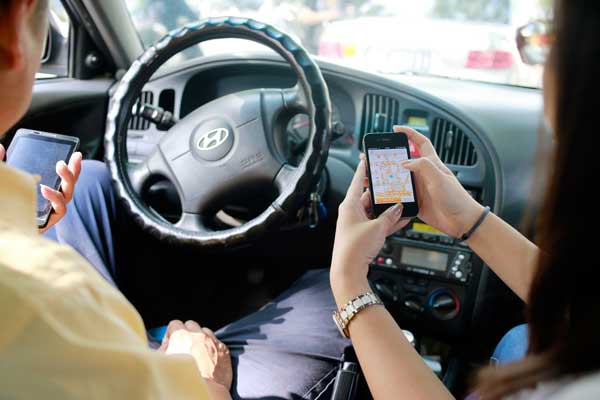
A passenger and taxi driver look up information on didi taxi, one of the first four taxi apps integrated into the public dispatching platform, 96106, in Beijing. Feng Yongbin / China Daily |
The difficulty in hailing a cab has seen a surge in the number of taxi apps.
Kuaidi taxi is particularly popular in the Shanghai metropolitan area. Users type in their location and intended destination, or simply speak the address while pressing the voice button. When nearby drivers receive the message, they click on a button and confirm the passenger's location.
"I think it offers great convenience. Seventy percent of taxi drivers in Ningbo use kuaidi, and now I have far less idle time. I basically earn 200 yuan ($32) more each day with this app," said Leng Guoquan, a taxi driver in Ningbo.
But like any other emerging sector, taxi apps are attracting too many operators who basically provide the same service. As of July, there were about 50 taxi-hailing apps in China, among which the most popular apps kuaidi taxi and didi taxi each had a market share of about 39 percent, followed by yaoyao taxi with 12.3 percent and E-taxi with 3.6 percent, according to android platform download statistics from EnfoDesk Analysis International.
The overheated competition has led to an unruly marketplace. Small companies, in order to survive against the big players, have planted too many advertisements in the apps. Some app designs allow passengers to bid for taxis at much higher fares than normal. The surcharge ends up in the pocket of the driver.
Consequently, feedbacks from passengers is not all positive. Liu Wenzhong, an office worker in Bejing, was dropped by a taxi driver in the middle of a traffic jam. Liu believed the driver had received an offer for the lucrative airport run.
Safety is another concern. Liu Zhongnan, a Bejing taxi driver, admitted he used to subscribe to two or three such apps, and kept checking them while driving.
3 main concerns
Many cities launched crackdowns on some of these apps in an effort to restore more order to the market. Shenzhen even took an initiative in May that required all taxi drivers to remove the apps.
Han Biao, a professor at Shenzhen University, said the ban was caused by three main concerns. "Bidding up the fares, anything from 5 yuan to 30 yuan, violates the taxi regulation that forbids negotiated prices. Bidding and ordering without checking the real identity of the driver may attract unlicensed ‘black cabs', and some drivers pick up their phones while driving to confirm the location and this is also against traffic rules," he said.
Although the authority banned the use of taxi apps, the reality was a different story. Many taxi drivers bring two mobile phones — one with the app installed, one without, in case of being stopped for inspection.
In Bejing, the crackdown was milder. Instead of a total shutdown, the city's transport commission stopped the bidding feature and mandated all taxi apps be integrated into a public dispatch platform called 96106 that distributes orders among the city's official five dispatch centers. A call fee of 5 yuan was allowed.
Didi taxi, the most popular app in Beijing and Guangzhou, was among the first four taxi apps that integrated into the service platform. Cheng Wei, CEO of didi taxi, said, "With the official dispatch centers coming in, it will help taxi app companies provide better service." Kuaidi and didi both strengthened the verification process for taxi drivers.
However, the integration also raised concerns. "I think the biggest draw of taxi apps is that they are much more efficient than directly calling a taxi from the official dispatch center," Liu Xi, a regular passenger said. "I wonder if this new platform will diminish that advantage."
Liu also complained about the removal of the voice feature that confirmed a passenger's location. "Before the app was integrated into the official platform, you could simply say where you wanted to go. Now the feature has been removed, I have to type it word by word. I don't know why they removed that feature."
Despite all that, Liu Zhongnan, a Bejing taxi driver, said the taxi app still helps him, even though the Win-to-Bid feature has been dismantled. "With the app, I at least know where the nearby passengers are and where they are going. This has saved me a lot of unnecessary expenditure," Liu said.