 |
|
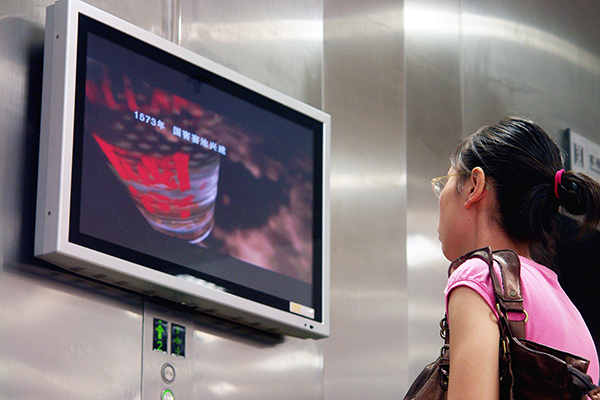
An advertisement shown on a video screen in the lobby of a residential complex building in Nanjing, capital of Jiangsu province. [Photo/China Daily] |
Various advertisements are sometimes so disturbing that I habitually switch them off as soon as they appear on my cell phone, my laptop or personal computers at home and in the office.
But the freedom of choice is not always there. I simply cannot ignore the advertisements that are posted and regularly updated at the entrances of my residential community, and the lobby and elevators of my apartment building.
The advertisements, most shown on video screens and on framed boards, present everything considered to be the daily necessities of life-food and beverages, fashion and healthcare items, overseas education and financial services, new home project promotions and luxury cruise tours, and special sales announcements from internet retail giants like Alibaba Group Holding Ltd and JD.com Ltd, to name just a few.
The country's community advertising market is being eagerly pounced upon by ad agencies and manufacturers because it precisely and effectively targets high-end and well-off urban residents.
The blossoming community advertising business has certainly brought in handsome revenue for the providers of the advertising space-the residential communities.
But how much have the communities earned and where has the money gone or what has been done with the money?
The Property Law, effective from Oct 1, 2007, rules that all residential community revenue earned from commercial activities such as advertising in public open areas, parking lots, lobbies and elevators, belongs to every homeowner in the community.
My community management office has been too shy to show we homeowners a single sheet of income and expenditure of the advertisement earnings ever since.
And it would be something the money has been spent on community services but all refused to publish a revenue and expenditure list.
While many community service managements are trying every means to keep the homeowners in the dark, on the other side of the coin, is the fact that many homeowners, as many as about 70 percent, according to surveys conducted by local media in cities across the country, have no knowledge that they have a legitimate right to share community advertising revenues.
Urbanization is moving fast in China and the building of numerous high-rises to accommodate urban residents has boosted the use of elevators.
Statistics from the General Administration of Quality Supervision, Inspection and Quarantine showed that by the end of 2014, the number of elevators had reached 3.6 million, making China the country with the most elevators in the world.
China has 650 cities and they are home to 750 million residents, more than half of the country's population. The annual income of residential community advertising businesses was estimated at 10 billion yuan ($1.5 billion), according to experts.
And more people are moving into cities as the urbanization rate is expected to rise from 58 percent in 2015 to 60 percent in 2020.
Protection of urban residents' legal rights is therefore becoming an important and urgent issue on the city management agenda for local governments in China.
Although there are relevant laws and regulations governing residential community affairs in service, weak supervision and the failure of the community service managements-in conducting their duties in line with the law-h(huán)ave created loopholes in the residential community advertising market and infringed homeowners' rights as a result.
Stronger supervision by the authorities can make these businesses more transparent and help ensure that homeowners become real beneficiaries of advertising revenues of residential communities.
The authorities should also ensure that the content of community advertisements is clean and heathy and does not harm young residents.
In managing community affairs and building happy and harmonious communities, local governments may learn from the practice of developed countries such as the United States, which has established thousands of homeowner associations that take good care of community affairs.
I would like to see a situation in which community advertising becomes an attractive business platform, which updates residents with information about the commercial world and warms our hearts by creating better welfare and management services, and a better community environment.


Copyright 1995 - . All rights reserved. The content (including but not limited to text, photo, multimedia information, etc) published in this site belongs to China Daily Information Co (CDIC). Without written authorization from CDIC, such content shall not be republished or used in any form. Note: Browsers with 1024*768 or higher resolution are suggested for this site.
License for publishing multimedia online 0108263 Registration Number: 130349