Comments
  Print
Print  Mail
Mail  Large Medium Small
Resolute measures should be adopted to make nation's income distribution more transparent and equitable
The hope of transforming the economic development model in the 12th Five-Year Plan Period (2011-15) lies in increasing urban and rural residents' incomes to release their consumption potential and so form an endogenous impetus for economic growth and a new pattern of equitable and sustainable development.
Income distribution remains systematically and institutionally unbalanced, with the distribution of the nation's wealth tilted toward the government and the enterprise sector.
There is a continuous widening of the income gap across regions, between urban and rural residents and between different social groups, chaos in income distribution in some sectors, and the expansion of vested interests. This has led to weak domestic consumption that fails to stimulate economic growth, which has made the imbalance between investment and consumption more and more serious.
 |
Instead of enriching people first, the current growth pattern enriches the State first, and the improvement of the productivity of the whole country is faster than the strengthening of the consumption capacity of the general public.
This can be seen from the following: the growth of GDP has been much more rapid than the growth of urban and rural residents' incomes, the growth of State revenues has been twice as fast as the growth of GDP, and the expansion of State-owned capital has been accelerating. It can be said that the growth model based on enriching the national coffers first as a transitional model has made historical contributions to the expansion of the total economic size and to ending the shortage economy.
In the next 5-10 years, the prerequisite for China's consumption-led economic transformation to succeed is the improvement of urban and rural residents' consumption capacity. This calls for speeding up income distribution reform.
In the first place, more efforts have to be made to readjust the national income distribution structure in order to enlarge the share of the labor remuneration in primary distribution. Second, incorporation of migrant rural workers into cities should be accelerated. Third, the process of equalizing access to urban and rural basic public services should be strengthened so as to ensure people's well-being.
Changing the national income distribution pattern needs to increase the number of middle-income earners. These earners now comprise only about 20 percent of the population. There needs to be relevant policies and institutional arrangements to increase the number of middle-income earners to support China's consumption-led economic transformation. Therefore, efforts should be made to increase the number of middle-income earners by 2 percentage points a year to 40 percent of the total population by 2020. With the ongoing fast urbanization and development of the tertiary sector, this goal is realistic. Some studies have shown that there will be 520 million middle-income earners by 2025.
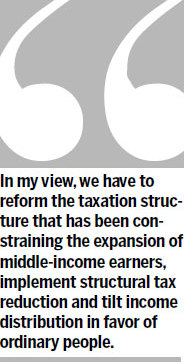
In my view, we have to reform the taxation structure that has been constraining the expansion of middle-income earners, implement structural tax reduction and tilt income distribution in favor of ordinary people. Protection of residents' property rights in general and rural residents' land property rights in particular should be further strengthened. Mechanisms to enable rural residents to fairly share the added value of land should be established. In this way, rural residents can accumulate their wealth from the added value of their land.
Changing the national income distribution pattern needs to be open and transparent. The current unbalanced distribution reflects the institutional arrangements of vested interests. Due to the lack of basic institutions for making income distribution open and transparent, departmental and sectoral interests, corruption and the sources of grey income are increasing rather than decreasing.
Take the governance of sangong for an example. The term refers to the management of government spending on overseas visits, the purchase and maintenance of government vehicles, and official receptions, the monitoring of which has been very difficult over the past years. This is because they are not put in the "sunlight". In the face of the serious imbalance of interest relations, it is high time to make the budgets of all levels of government open and transparent. And in the next 2-3 years, mechanisms for all government officials to disclose their property should be in place.
It is also imperative to establish institutions for registering people's incomes and reporting tax payments with more determination. Efforts should be made for these institutions to cover all urban residents by the end of the 2015 and all rural residents by 2020.
Straightening out income distribution relations so they are open and transparent is not really a technical issue but one of determination and courage.
The author is president of the China Institute for Reform and Development.
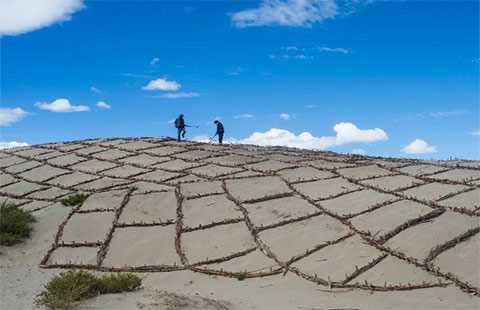 Govt Carries out conservation program in Tibet
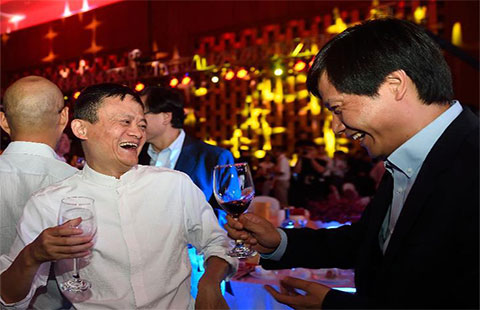 Business giants celebrate the success of entrepreneurship
 Top 10 Chinese businesswomen in 2015
 Female robot sings in Shanghai
 21st Lanzhou Investment and Trade Fair kicks off in Lanzhou
 Top 10 Chinese brokerage firms in H1 of 2015
 Fancy sculptures sparkle in Chongqing
 Top 10 most competitive Chinese cities in Belt and Road Initiative

Copyright 1995 - . All rights reserved. The content (including but not limited to text, photo, multimedia information, etc) published in this site belongs to China Daily Information Co (CDIC). Without written authorization from CDIC, such content shall not be republished or used in any form. Note: Browsers with 1024*768 or higher resolution are suggested for this site.
License for publishing multimedia online 0108263 Registration Number: 20100000002731