Top Stories
Zoning in on success
By Zhang Yuchen in Guangdong, Wei Tian in Fujian and Huang Yiming in Hainan, with Li Yao (China Daily)
Updated: 2010-08-19 09:05
 |
Large Medium Small |
Thirty years after their introduction, residents reflect on the effects of special economic zones.
The initials are synonymous with success and have been credited with providing much of the driving force behind China's rapid economic development. For three decades special economic zones (SEZs) have helped change the fortunes of millions of people.
The literally groundbreaking SEZ initiative, which next week marks its 30th anniversary, was intended to enable local governments to adopt favorable measures to attract fresh investment and jobs. And it worked to such an extent that other countries soon deployed the formula.
Shenzhen, Zhuhai and Shantou in Guangdong province, Xiamen in Fujian province and the entire island of Hainan have benefited hugely, progressing in some cases from remote backwaters to thriving cities. Shenzhen, arguably the most successful of the five, developed from a small village into a city of more than 10 million people in just two decades.
After witnessing the effect the SEZs had in China, several countries copied the model, including Brazil, India, Iran, Kazakhstan, Pakistan, the Philippines, Poland, Russia, Cambodia and the Democratic People's Republic of Korea, the Economy Information Weekly, a Chengdu-based academic-oriented newspaper, reported.
As of 2007, more than 3,000 projects have been launched in SEZs in 120 countries worldwide, according to the World Bank.
Yet, there have been many bumps on the road to prosperity in China, such as a widening wealth gap and real estate bubbles. Today, as the nation's SEZs reach maturity, their traditional strengths are beginning to weaken as new challenges loom.
Inside, China Daily reporters recount the stories of five people who have witnessed firsthand the changes in China's SEZs, learning about the highs the lows they have encountered, the struggles and the accomplishments.
|
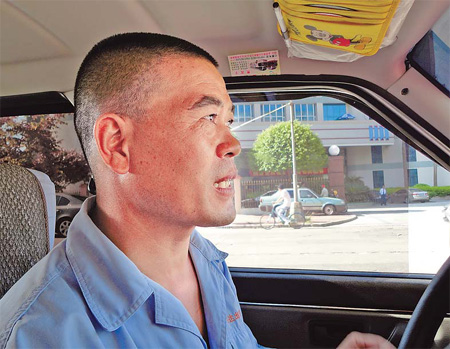 Zhang Jianping, a taxi driver from Hunan, has witnessed many changes in the city of Shantou during the past two decades. Zhang Yuchen / China Daily |
Driving force behind the rise
SHANTOU - Zhang Jianping has witnessed the economic ebb and flow in Shantou since 1990, when he made the city in Guangdong province his new home.
After quitting the army, the father of one originally returned to his native Xiangtan in Hunan province to till less than half a hectare of farmland with his family.
But the harvest was not enough to support them and he soon set off with his friends in search of a better life in Shantou, one of the country's five special economic zones (SEZs).
"At the first sight of Shantou I was astounded by the environment," said Zhang. "It was like a different world. Or, to put it another way, a changed world."
Before his arrival, he had heard money was easy to come by in the rapidly expanding city "but that was only for those with guangxi (connections) with the municipal officials or above".
Even without the contacts, Zhang, now 46, found Shantou offered a wealth of opportunities.
"I began to drive a taxi in the 1990s, when the first economic boom began and the many new millionaires started spending money as quickly as they collected it from foreign investors.
"They (nouveau riche) didn't seem to be prepared for the massive wealth they were making or how to spend it. I was driving many of them to the clubs and bars, where they would spend hundreds of thousands on karaoke."
At the time, Zhang was making hundreds of yuan a day and said it was the great time of Shantou's development.
"It was energetic, prosperous and there was a lot of desire," he said.
Zhang decided to invest the money he had made into a plastics factory venture with his friend from his hometown. Although his friend made a profit, he lost his savings.
"I learned that doing business is not the way I'm going to get rich," said Zhang, who abandoned his studies after elementary school.
The prosperity lasted only a couple of years and by the late 1990s, as the authority tightened the rules on the import-export trade to clamp down on smuggling, small and medium-sized enterprises were already starting to leave Shantou. As the companies moved on, so did the workforce.
"My son now works in Guangzhou where there are opportunities," said Zhang, who today earns about 4,000 yuan a month as a taxi driver. "The economic slowdown (in recent years) means Shantou is comparatively less developed.
"I'll still work here, though. At least it is better than home," he added.
More SEZ stories:
Paint boss hails fantasy island
Father laments the end of quiet lifestyle