

Half of major SOEs' profits set to be made from abroad
Updated: 2013-07-30 07:14


Better use of resources and choice of market to help meet the target
Half of central government State-owned enterprises' profits will come from their overseas operations in the next five years, compared with less than 38 percent at present, according to the State-owned assets watchdog.
The target can be achieved through better allocation of resources, choice of market, brand-building and industrial upgrading, rather than asset acquisitions, experts say.
"We will focus on the structure of corporate profits when we evaluate central SOEs' international operations in the next few years," said Liu Nanchang, director of the Performance Evaluation Bureau of the State-owned Assets Supervision and Administration Commission.
The SOEs' international networks and business scale will also be key criteria in the assessment, he added.
Since 2003, when the commission was formed, it has carried out annual reviews on the performance of central SOEs and their leaders.
At the start of the nation's 12th Five-Year Plan (2011-15), the commission made it a top priority to develop central SOEs into top multinationals globally.
Forty-four central SOEs are listed on the Fortune Global 500 in 2013, with China Petrochemical Corp, China National Petroleum Corp and State Grid Corp in the top 10.
The Fortune Global 500 is an annual ranking of the top 500 corporations worldwide, measured by revenue. It is compiled and published by Fortune magazine.
Liu said: "We plan to take five to 10 years to allocate the major part of central SOEs' resources in global markets.
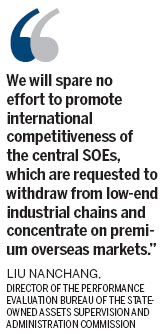
"We will spare no effort to promote international competitiveness of the central SOEs, which are requested to withdraw from low-end industrial chains and concentrate on premium overseas markets."
Overseas assets of Chinese companies, which have more than 15,000 branches worldwide, are valued at more than $1 trillion, with half coming from State-owned enterprises, according to the commission.
But compared with their foreign counterparts, the overseas business of Chinese enterprises still accounts for a relatively small proportion, according
to Kang Yan, senior partner at Roland Berger Strategy Consultants (Shanghai).
He attributes this to a lack of motivation.
While Japanese and South Korean companies have faced shrinking domestic markets, Chinese enterprises have generated large profits from the domestic market in recent years, making them less eager to tap the international market, according to Kang.
Samsung Electronics began its internationalization drive as early as the 1970s by continuously establishing sales networks and production bases in major markets such as the United States, the United Kingdom, Mexico and China.
As a result, Samsung accounted for 23.6 percent of the world market for mobiles in the first quarter of this year, the leading position globally, according to US market research firm Gartner Inc.
China National Petroleum Corp, with assets worth more than 3 trillion yuan ($488.7 billion), overtook Exxon Mobil and Royal Dutch Shell in value last year. But its overseas revenue accounted for only 20 percent of its total income, compared with about 70 percent for Exxon Mobil and Shell.
Huang Shuhe, the commission's vice-chairman, said earlier that Chinese SOEs should follow the example of major multinationals in their global expansion.
But Kang said it will take a long time for Chinese companies to increase their international competitiveness.
Currently, many central SOEs focus on the acquisition of foreign assets to expand their international reach. But Kang said they can generate more profits from "an optimized network layout", a complete industry chain and business operations that directly serve customers in foreign markets.
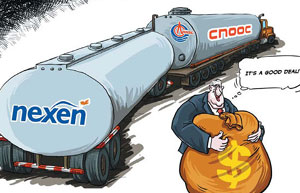
One example is China National Offshore Oil Corp, which acquired Canadian energy group Nexen in February.
The State-owned oil and gas producer plans to list its shares in Canada and establish its North American headquarters in the country, reflecting a new strategy for Chinese SOEs investing abroad.




- BYD exports three electric cars to Thailand
- Grid gets first jolt of residential solar power
- US now largest buyer of China's exports
- China's outbound M&As on the rise
- Tobacco control may entail price, tax rises
- Quanzhou becomes pilot financial reform zone
- New automobiles shine at Geneva Motor Show
- World's longest high-speed rail 'on track'
- Jiugui Liquor involved in plasticizer scandal again
- Accident reignites school bus safety concerns
- China to revise labor law
- Trademark registration under scrutiny
- Dinner ban takes toll on liquor firms
- CIC tables bid for London's Chiswick Park
- Property buyers eye overseas market
- Call for law to protect personal information
- China to cut train ticket prices
- Christmas business
- Solar industry to get jolt from new policies
- KFC chicken under spotlight
Survey & Comments