

BRICS looks at funding pool, money exchanges
Updated: 2012-06-20 10:12


|
 |
|
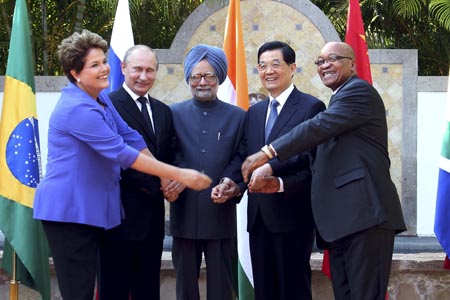
President Hu Jintao (second right), Brazilian President Dilma Rousseff (left), Russian President Vladimir Putin (second left), Indian Prime Minister Manmohan Singh (center) and South African President Jacob Zuma pose for a picture after a BRICS leaders' meeting in Los Cabos on Monday. The leaders are in Los Cabos, Mexico, for the G20 Summit.?[Photo/Xinhua] |
The BRICS countries said on Monday that they're considering setting up a foreign-exchange reserve pool and a currency-swap arrangement as financial problems threaten to spread across the global economy.
Leaders of the five-member group -Brazil, Russia, India, China and South Africa - also said BRICS is "willing to make a contribution" to increase the International Monetary Fund's ability to rescue troubled economies.
President Hu Jintao joined his counterparts from other BRICS nations on Monday morning in the Mexican resort city Los Cabos ahead of the start of the G20 Summit.
According to the Chinese Foreign Ministry, the leaders discussed the currency swap and foreign-exchange reserve pool ideas and tasked their finance ministers and central bank chiefs to implement them, according to China's Foreign Ministry.
Swap arrangements, which allow nations' central banks to lend to each other money to keep markets liquid, and the pooling of foreign-exchange reserves are contingency measures aimed at containing crises such as the one roiling the eurozone, analysts said.
Zhang Yuyan, director of the Institute of World Economics and Politics affiliated with the Chinese Academy of Social Sciences, said the new mechanisms established by the emerging markets themselves, who "know their current conditions and demands much better".
Amid the global economic slowdown, the pooling of foreign-exchange reserves will help BRICS countries to fight the lack of market liquidity, beef up their immunity to financial crises and boost global confidence, Zhang said.
Contributions to this "virtual" bailout fund, as Brazil's Finance Minister Guido Mantega put it, would be tied to the size of each BRICS member's currency reserves, he said.
The five leaders also discussed BRICS' participation in replenishing the IMF's lending capital.
Hu said the G20 should encourage and support the eurozone countries' adoption of fiscal controls and spending cuts as efforts to improve confidence in world markets.
The leaders also urged the IMF to carry out promised reforms of its quota and governance systems.
Mexico, which was hosting the G20 Summit on Monday and Tuesday, has said it will use the meeting to press the world's largest economies to increase IMF resources and build the fund's capacity to intervene in the European debt crisis.
A boost in IMF funding makes sense and gives emerging economies such as China a greater role, according to Yukon Huang, senior associate at the Carnegie Endowment for International Peace and a former World Bank country director for China.
"Support for a larger IMF role solves several problems. Any solution involving the IMF represents a more collective and coordinated approach and is thus less politically driven and more sustainable since it implies that the right policy actions have been agreed on," Huang told China Daily.
"And if the increased liquidity is not enough, then proposals such as a currency swap and pooling of reserves provide other options. These measures were supported by China as well as affected countries during the Asian financial crisis 15 years ago to provide assurance that additional resources could be available if needed," he said.
The BRICS now boast about 42 percent of the world's population and more than a quarter of its land. According to IMF estimates, the five had a combined nominal gross domestic product of $13.6 trillion in 2011, about 19.5 percent of the global total.
Since 2010, more than 50 percent of global growth has come from the BRICS, and it has become an important force in easing the international financial and economic crisis, driving regional and global economic growth.
Contact the writers at wujiao@chinadaily.com.cn and atung@chinadailyusa.com.
Zhang Yunbi in Beijing contributed to this story.
Related Links



- BYD exports three electric cars to Thailand
- Grid gets first jolt of residential solar power
- US now largest buyer of China's exports
- China's outbound M&As on the rise
- Tobacco control may entail price, tax rises
- Quanzhou becomes pilot financial reform zone
- New automobiles shine at Geneva Motor Show
- World's longest high-speed rail 'on track'
- Jiugui Liquor involved in plasticizer scandal again
- Accident reignites school bus safety concerns
- China to revise labor law
- Trademark registration under scrutiny
- Dinner ban takes toll on liquor firms
- CIC tables bid for London's Chiswick Park
- Property buyers eye overseas market
- Call for law to protect personal information
- China to cut train ticket prices
- Christmas business
- Solar industry to get jolt from new policies
- KFC chicken under spotlight
Survey & Comments