Ministry, experts mull over future of electric market


 |
|
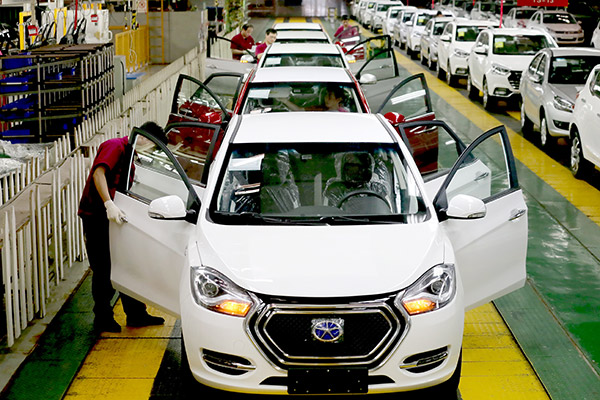
A worker checks new energy cars on a production line of JAC Motors in Anhui province. [Xu Congjun/for China Daily] |
At a time when the nation's new energy auto market is expanding steadily, Chinese authorities are mulling their next steps to ensure the healthy development of the sector, where many questions remain on the table.
New energy vehicle sales hit 68,000 last month, a 76.3 percent surge compared with the same month last year, data from the China Association of Automobile Manufacturers showed on Sept 12.
In the first eight months of the year, new energy car sales totaled about 320,000 vehicles, jumping 30.2 percent year-on-year. This contributed 1.8 percent to the entire auto market, which expanded by 4.3 percent year-on-year to 17.51 million vehicles sold.
The electric vehicle boom is recognized as being a result of the country's intensified financial efforts, including tax deductions and subsidies.
The Ministry of Finance is mulling further supportive policies beyond financial approaches, given the subsidy scheme will fade out by 2021.
"The support for the new energy vehicle sector will not be severed. Rather, the supervision of new energy vehicle-related projects and funds will be strengthened," Song Qiuling, deputy director of the economic construction department of the Ministry of Finance, told a forum in Tianjin on Sept 9.
"Through the supervision system, the ministry will keep abreast of the sector's new developments, covering raw materials, procurements, production, sales, operations, funding applications and approval."
The subsidy fade-out scheme was announced in August 2016, six months after a scandal in February 2016 when automakers were discovered to be abusing the support offered.
This year, the cash allowance for fully electric passenger cars dropped by 40 percent.
The Society of Automotive Engineers of China's secretary-general, Zhang Jinhua, said: "The financial and taxation policies have already made their critical contribution to the development of the new energy vehicle sector."
Electric carmakers have maintained their production expansion, with some 346,000 vehicles rolling off production lines in the first eight months of the year, 33.5 percent more than in the same period last year. Overall, total auto output rose only 4.7 percent to 17.68 million vehicles.
After a market wobble in 2016, new energy vehicle sales are predicted to ramp up by 51.8 percent this year in China, and the market scale for electric cars will hit 700,000 vehicles annually, according to the Blue Book of New Energy Vehicles released by the China Automotive Technology and Research Center last month.
Wang Binggang, an expert working on the Ministry of Science and Technology's new energy vehicle research project, called for the specialized treatment of different sectors.
"The policy's rationale is critical to avoid insufficiency or excess."
The Chinese authorities define new energy vehicles as fully electric cars, plug-in hybrids and fuel cell cars, but exclude mild hybrids without plugs for recharging.
The majority of the new energy vehicles sold in the first eight months of the year were fully electric passenger cars, or blade battery electric cars, contributing about 65 percent to the total figure.
About 17 percent of the sales were plug-in hybrid electric passenger cars. Fully electric commercial vehicles had a 16-percent share, while the remaining 2 percent were plug-in hybrid commercial vehicles.
According to Xu Chaoqian, deputy director of the high and new-technology development department of the Ministry of Science and Technology, the country also needs to examine the current policies to systematically promote the development of fuel cells.
He said: "The development of fuel cell cars still requires significant effort, including finding synergy in innovation, international cooperation and speedy progress in industrialization."