Export slowdown puts damper on plans to go global


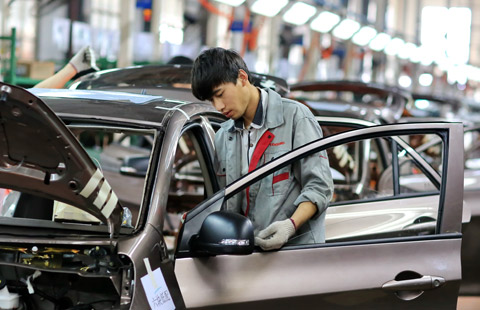
The recent downturn in exports by Chinese automakers poses a challenge for local companies that plan to expand globally, according to an industry report.
China exported 84,400 units in June, a decline of one-fifth from the same period last year, following a 16 percent year-on-year decrease in May, according to the China Association of Automobile Manufacturers.
Geely recently announced that it exported 9,337 units for the same period, a drop of 11 percent year-on-year.
Great Wall Motor, another domestic automaker also reported slowing growth momentum.
The company's exports for the first five months of 2013 totaled 33,453 units, down 11.8 percent year-on-year, local media reported.
Despite the setback, global expansion is still one of the most viable ways for Chinese automakers to grow big and competitive, according to the report.
First published in 2008, the annual research report named Blue Book of Automotive Industry on the development of China's auto industry is jointly compiled by the State Council Development Research Center, the China Automotive Engineering Institute and Volkswagen Group China.
According to the report, China has been the largest auto manufacturer and consumer globally for four consecutive years. The Chinese auto market is also among the most competitive.
"However, domestic market share has been largely occupied by stronger foreign automakers or joint ventures," according to the report.
"Since the home market leaves little room for domestic manufacturers, many have to turn their eyes to overseas emerging markets that are still full of opportunities."
The primary means for domestic automakers to go global is mainly by building what are known as "knock-down" factories overseas. These factories assemble cars from kits of parts that are imported in "knock-down" form, enabling carmakers to comply with laws requiring that cars be manufactured locally.
Industry insiders say these may help them ease some sales pressure in the short term but do not amount to real internationalization.
Anhui-based Chery Automobile Co was among the first Chinese automakers to tap the overseas markets.
Now the automaker has 17 knock-down factories that are operational or under construction.
They will generate an added annual production capacity of 900,000 vehicles and 900,000 engines as well as transmissions when they are finished.
Chery projects to create added sales of 2 million units by 2015, and 30 percent of the sales will come from overseas markets. Locally built factories can help the exporter to gain profits soon, but in the long term, benefits are limited since those factories normally sell many different brands, according to the report."It will make it difficult for Chinese automakers to establish their own brand image on a global scale," experts warned.
Currently, some domestic automakers have realized this and have taken alternative approaches to going global. One example is Zhejiang Geely Holding Group, which acquired Volvo Cars in 2010, making the Geely brand known to the world.
Prior to that merger, Geely had acquired Britain's Manganese Bronze Holdings PLC in 2006 and became its largest shareholder with 23 percent stock proportion.
In March 2009, Geely purchased the world's second-largest transmission company-the Drivetrain System International Holding Pty in Australia. Such mergers not only gave Geely a worldwide dealer network but also infused the company with technological strength. However, companies must be cautious of the risks involved in international mergers, said Jia Xinguang, an independent auto analyst on China's automotive industry since 1978.
For example, the enterprises acquired by Chinese automakers are often deep in debt, thus a lot of analysis is needed before a merger to see if it is worthwhile.
He also said that unstable political conditions and economic policies in foreign countries will pose a great threat to Chinese enterprises.
On the evening that the report was officially released, Fu Yuwu, president of China Automotive Engineering Institute, said China's automobile enterprises must have a long-term vision to do well in each and every detail, and accelerate their brand building in the international market.
"Internationalization is a strategic choice of China's automobile industry that cannot be accomplished at once. It is a long process of 'learning while doing', " Fu said.