Yet heavily polluting transient trucks pose challenge in capital
|
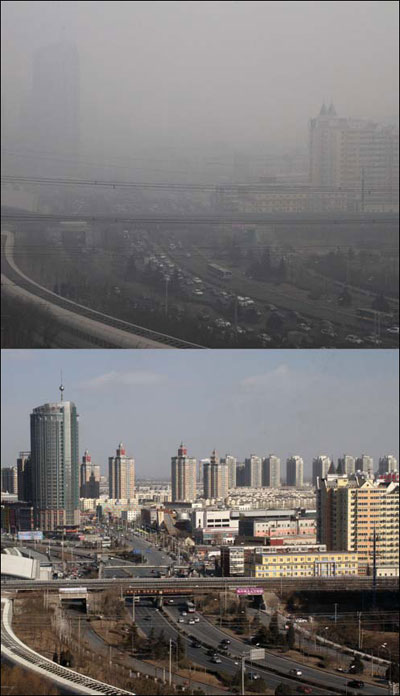
Sharp contrasts in traffic congestion and air quality in the Tiantongyuan community of northern Beijing. [Wu Changqing / For China Daily] |
On Feb 6, the State Council passed a timetable to upgrade fuel quality that says that the National V standard for automobile gasoline and diesel will be implemented nationwide before the end of 2017.
The National V standard requires sulfur content in the fuel to be no more than 10 parts per million (ppm).
Suffering under heavy pollution that made international headlines, Beijing became the only city nationwide to implement the National V standard when the municipal government adopted the more stringent requirement on Feb 1. Shanghai and Jiangsu province continue with the National IV standard that limits sulfur content to 50 ppm.
The central government released the National IV standard for gasoline two years ago but the deadline for national implementation was then set for 2014.
According to the most recent timetable, the State Council now calls for the country to implement the Nation IV standard for diesel in 2015.
Yet most parts of China still use the National III standard, which allows sulfur content of up to 150 ppm for gasoline and 350 ppm for diesel. The current standard in Europe is 10 ppm and in the US the restriction is 30 ppm.
Some areas of China even still allow the National II diesel standard that caps sulfur content at 2,000 ppm.
Market data shows that diesel trucks account for about a quarter of China's motor vehicles, but they generate nearly 80 percent of the total pollutants.
Though Beijing has now adopted the strictest fuel standards in the nation, experts warn that the poor quality diesel used in the surrounding cities will hinder the capital's efforts to improve air quality.
According to local media reports, the average number of commercial trucks - many of them low-tech diesels registered in areas with lower emission standards - that enter Beijing each night can hit 140,000.
And as the need for cleaner fuel becomes increasingly urgent, there is debate over who should pay the resulting higher costs.
Sinopec Corp, China's biggest oil refiner, recently said that it will invest about 30 billion yuan a year to improve fuel quality. By the end of this year the company will upgrade desulfurization technologies at 12 of its refineries.
Some analysts suggest the government should offer incentives such as tax rebates to encourage refinery improvements.
And customers will also pay part of the cost as fuel prices rise, they said.
Each ton of National V standard gasoline is nearly 500 yuan more expensive than National III products, according to estimates. The gap between National IV and National III products is about 400 yuan a ton.
In addition to cleaner fuel, improved car powertrains are also important, analysts said.
The push for quality fuel will affect the entire consumer chain, as higher gasoline prices will boost demand for energy-saving vehicles, said Cao He, an auto analyst with China Minzu Securities.
The move would force out small producers that are technically and financially unprepared for the upgrade, Cao said.
Du Fangci, advisor to the China Association of Automobile Manufacturers, noted that the most urgent problem now is to improve fuel efficiency of vehicles already on the road.
hantianyang@chinadaily.com.cn

Copyright 1995 - . All rights reserved. The content (including but not limited to text, photo, multimedia information, etc) published in this site belongs to China Daily Information Co (CDIC). Without written authorization from CDIC, such content shall not be republished or used in any form. Note: Browsers with 1024*768 or higher resolution are suggested for this site.
License for publishing multimedia online 0108263 Registration Number: 20100000002731