Steel Industry
Small steel mills face 'big' problems
By Zhang Qi (China Daily)
Updated: 2009-12-10 08:03
 |
Large Medium Small |
|
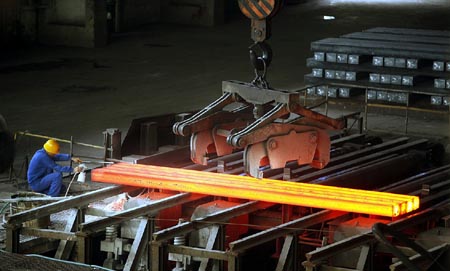 A man works at a steel mill in Jiangyin city, Jiangsu province. Mills should cap sewage discharge at 2 cu m and sulfur dioxide emission at 1.8 kg for every ton of steel made, according to a new government proposal. [CFP] |
Consolidation moves in the fragmented domestic steel industry are set to gather pace in the coming days as the government is contemplating restricting sector entry to mills having production capacity of at least 1 million tons or more annually.
The biggest casualties of such a move would be the small steel mills, who would now have no choice but to come together or get snapped up by bigger rivals, said industry sources.
The government has also decided to raise environmental standards for steel mills, forcing them to upgrade their equipment or have their licenses revoked, said a draft policy document released yesterday by the Ministry of Industry and Information Technology.
The proposals are yet to be implemented and have currently been sent for public feedback, the statement said.
As per the new guidelines, steel mills would now have to install blast furnaces of over 400 cu m, compared with the 300 cu m standard set in April this year.
| ||||


"Most of the smaller mills may find the going tough once the new norms come into place. Their survival would depend on the ability to tie up financing requirements and failure to do so would trigger a spree of mergers in the sector or closures," he said.
"The planned moves look contradictory to the government's intention to curb oversupply, especially when small steel mills expand their capacity to over 1 million tons," said Du Wei, a steel analyst with Umetals Research Institute. "The norms should also be backed up with supporting credit policies," he said.
According to the new environmental standards, mills should cap sewage discharge at 2 cu m and sulfur dioxide emission at 1.8 kg for every ton of steel made.
Government departments should not approve construction and upgrading if steel mills can't meet the requirements and should not issue sewage discharge and land permits, the draft proposal said.
Industry sources, however, maintain that Chinese government has taken the first steps as the fragmented industry could find itself at the mercy of the "Big Three" miners, namely BHP Billiton, Rio Tinto and Vale, for future iron ore supplies.
They point out that even big miners like Rio Tinto and BHP Billiton are on a consolidation mode, after they decided to merge their Australian iron ore operations into a new venture. By forcing the small steel mills to join hands, the Chinese government expects to build up enough firepower to match up to the international miners.
However, the industry also faces an acute oversupply situation and that could dent future profitability, said China Iron and Steel Association (CISA).
"Oversupply problems have weighed heavily on steel prices and squeezed profit margins. This could lead to a more difficult situation next year also," Luo Bingsheng, vice-chairman of CISA, said earlier.