BEIJING - The battle for the country's wetlands rages in China as farmers eager to boost meager incomes butt heads with government initiatives to preserve biodiversity.
China's vast area of wetlands remain under constant threat from human activities. Despite their crucial role preserving water resources and biodiversity, they are often the first casualties of rapidly expanding cities and growing demands for agriculture.
In a tour to several wetlands in Northeast China's Heilongjiang province, Xinhua reporters found that although the government is increasing efforts to curb the degradation of wetlands, local residents are still attempting to convert them to agricultural lands as incomes remain low in the undeveloped region.
|
 |
|
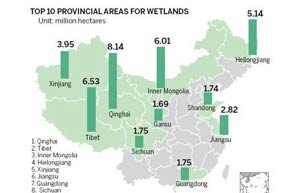 |
Data from the State Forestry Administration (SFA) revealed that China has a total of 53.6 million hectares of wetlands, making up more than 5 percent of the country's total terrain. In the past decade, 8.82 percent of wetlands have disappeared, converted to farmland or for infrastructure.
Sometimes referred to as the "Kidney of the Earth", wetlands play a crucial role in helping preserve and filter natural water resources while offering sanctuary for migrant birds and many other species.
A report in April showed nearly 60 percent of monitored areas in China had "very poor" or "relatively poor" underground water quality last year.
At a time when China faces looming pollution and water shortage problems, the government needs to put more focus on recovering wetlands, analysts said.
The problem, however, lies in how wetlands are classified.
According to Chinese law on land management, land is categorized as rural, up for development or unutilized. Unqualified for the former two categories, wetlands fall under the unutilized category allowing them to be misappropriated under "rightful exploration."
"Wetlands protection involves the interests of several departments, including forestry, agriculture and environment, so its difficult to enforce regulations," Yu Hongxian, from Northeast Forestry University, said.
In May 2013, the SFA implemented wetland protection regulations which would have banned the use of wetlands for other purposes. The 33-article document laid out detailed restrictions on issues such as overgrazing, misappropriation, introduction of alien species and misuse of wild fauna and flora.
However, the policy lacked specific consequences for violating the regulations and was not adopted by other departments which oversee wetland use, instead falling dead in the water.
The deadlock has prompted calls for a unified legal framework to preserve the irreplaceable ecosystem.
Ma Guangren, head of the wetlands protection and management center under the SFA, said the absence of a national protection law for wetlands is due to a lack of social awareness.
To better protect the wetlands, China needs to single them out as an independent category to specify regulation in the area, he advised.


Copyright 1995 - . All rights reserved. The content (including but not limited to text, photo, multimedia information, etc) published in this site belongs to China Daily Information Co (CDIC). Without written authorization from CDIC, such content shall not be republished or used in any form. Note: Browsers with 1024*768 or higher resolution are suggested for this site.
License for publishing multimedia online 0108263 Registration Number: 130349