|
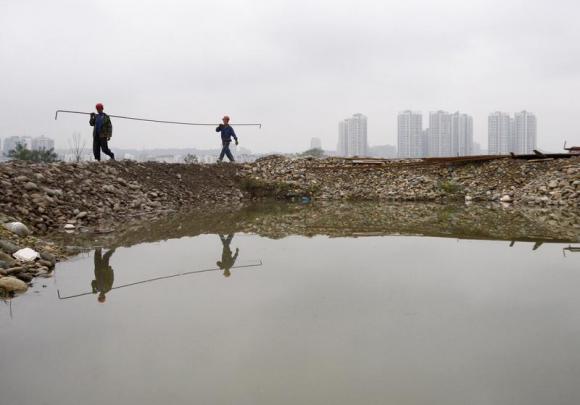 Labourers carry a steel bar at a construction site of a wetland park in Suining, Sichuan province Oct 14, 2009. [Photo / Agencies] |
Nearly 9 percent of China's wetlands have vanished over the past decade as urban development has increased, a change that experts said shows the need for regulation to protect the natural resource.
A report of the second national survey of wetlands resources, released on Monday, said that more than 3.39 million hectares of wetlands have disappeared since the first national survey 10 years ago, even though more wetlands are under conservation today.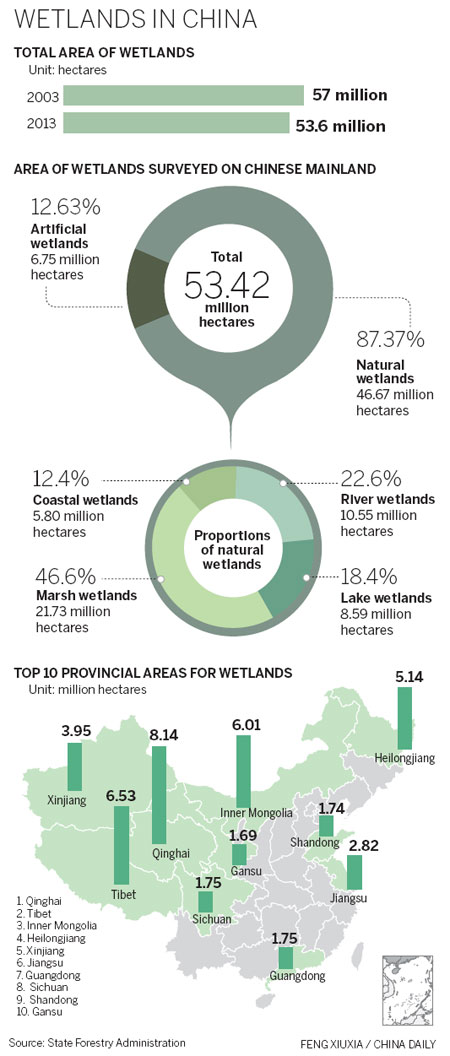
"The wetlands we lost in the last decade equal about 3 percent of the national territory," said Zhang Yongli, deputy director of the State Forestry Ad
Zhang said that since the first survey, the threats to wetlands have grown from three to five. Ten years ago, pollution, land reclamation and illegal hunting were the key threats. Today they are pollution, excessive fishing and gathering, land reclamation, invasion of alien species, and occupation by infrastructure, he said. Zhang said that absence of wetland-conservation legislation is now a big concern. "We need to step up legislation," he said. "China should promulgate the National Wetlands Conservation Regulation as quickly as possible to clearly define powers and responsibilities, administrative procedure and a code of conduct in wetland conservation." China joined the Ramsar Convention on Wetlands in 1992 but still hasn't enacted a national regulation as the convention requires. Zhang said that it is because different interest groups are battling over the legislation. According to the survey, half of the wetland areas are in less-developed western China, which is undergoing urbanization and economic development. He said that an "eco-red line" is needed to prevent overdevelopment of urbanization and industrialization. Zhang said that total funding of 12.9 million yuan ($2.13 million) from the 12th Five-Year Plan (2011-15) has been prepared by the central and local governments for wetland conservation. "How to use and supervise the money flow needs to be checked by an independent third party to make sure that the money is used effectively," said Lei Guangchun, a professor from the Chinese Forestry University. He also urged the establishment of an ecological compensation mechanism. "Residents of the wetlands need to get economic compensation as they will, more or less, sacrifice either agricultural land or construction land due to conservation," Lei said. "If they get proper compensation, their motivation to better protect the wetlands will go up." Companies, communities and NGOs, in addition to governments, should also participate in conservation, said Lei Gang, freshwater director of World Wildlife Fund-China. "This includes protecting bio-diversity, building a network to protect migratory water birds, etc", he said. "Also it is important to learn cutting-edge technology and cooperate with different departments." Chen Kelin, China director of Wetlands International, agreed. "Wetlands store a large amount of China's freshwater resources, and receding wetlands will leave less water available in the long term. It plays a key importance in building a resilient society," he said.


Copyright 1995 - . All rights reserved. The content (including but not limited to text, photo, multimedia information, etc) published in this site belongs to China Daily Information Co (CDIC). Without written authorization from CDIC, such content shall not be republished or used in any form. Note: Browsers with 1024*768 or higher resolution are suggested for this site.
License for publishing multimedia online 0108263 Registration Number: 130349