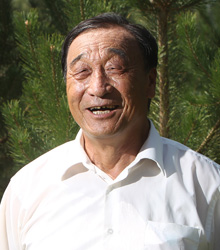
Zhang Yongli, deputy director of the SFA, said that the program's specific goals and ethos have changed with the times to reflect the changing needs of the country. According to him, initially, focus was on planting as many trees as possible to reduce the speed of winds blowing out from the deserts. However, in the early 1990s, the SFA suggested that windbreaks with better economic returns be created so as to give local farmers better incentives to plant trees. In recent years, the SFA has advocated combining efforts to build new shelterbelts with the building of different types of agricultural bases.
Zhang said that thanks to the Three-North Shelterbelt Program, local farmers started to report consecutive high-yield harvests, local needs for wood have been satisfied, locally produced fruit and nuts have been exported or sold to other parts of China, and the tourism industry in the region has been developed. All these have helped to enrich the lives of the local people.
"The program has also improved local farmers' living environment and accelerated the improvement of infrastructure in the countryside as well as theurbanization process," Zhang told Xinhua.
Fighting the sands
Growing trees in areas prone to droughts and sandstorms and keeping them alive is never easy. Nobody knows this better than 68-year-old Shi Guangyin, who considers battling desertification his life-calling. Born in a sand-struck village in Dingbian County, northwest China's Shaanxi Province, Shi has struggled his way through sandstorms since he was a child. Haunting memories of a tragedy he witnessed when he was 7 spurred him to assume the role of an ecological guardian.
|
|
|
ECO-WARRIOR: Shi Guangyin has dedicated 30 years to planting trees to restore the land surrounding his hometown in Dingbian county, Shaanxi province. |
Shi was herding sheep with a 5-year-old boy in the neighborhood one day when a sudden sandstorm swept them away. Shi was submerged in sand so deep it was days before his dad found him nearly 30 km away from their home, but his friend was never found again. "When I was saved, I decided that when I grew up the only thing I wanted to do was to prevent sandstorms," Shi recalled.
In 1984, the government introduced a policy that encourages afforestation efforts undertaken by individuals. Shi responded immediately and became the first contractor to plant trees in a 2-square-km barren desert land. Shi went to nearly every door in his village to recruit more to join him. That year, he formed a team with seven other rural families and sold all his livestock, all his family's valuables, and secured two bank loans to raise money to buy saplings. Finally, 85 percent of the trees they planted survived.
Encouraged by the initial success, Shi founded a company in 1985 to specialize in afforesting degraded lands.
In 1986, Shi's company were contracted more than 1,000 plots of barren land that covered a combined 39 square km. Among them, one area known as Langwosha, which covers 4 square km, was the most difficult to afforest. Shi spent a whole spring with his team, but high winds killed 90 percent of the saplings.
The next spring saw the same failures. Two defeats lowered their morale, but Shi refused to lose his resolve. He persuaded the team not to give up and at the same time turned to forestry professionals to remake planting strategies.
In the spring of 1988, Shi and his team took on Langwosha one last time. This time, they put up an 800-km-long sand-proof screen to protect the saplings and put down grass to stop the sand on the ground flowing as freely. With 80 percent of saplings surviving, Langwosha had finally been afforested.
To date, Shi's company has dealt with 167 square km of barren land and successfully transformed 90 percent of it into lush green forest covers.
Trees planted by Shi's company are estimated to be worth 120 million yuan ($19.7 million) in total. His company also owns a potato breeding base, livestock farms, a landscaping business and three recreational centers. Shi was honored as an "outstanding planter in the Asia-Pacific region" by the UN Food and Agriculture Organization in 2002.


Copyright 1995 - . All rights reserved. The content (including but not limited to text, photo, multimedia information, etc) published in this site belongs to China Daily Information Co (CDIC). Without written authorization from CDIC, such content shall not be republished or used in any form. Note: Browsers with 1024*768 or higher resolution are suggested for this site.
License for publishing multimedia online 0108263 Registration Number: 130349