|
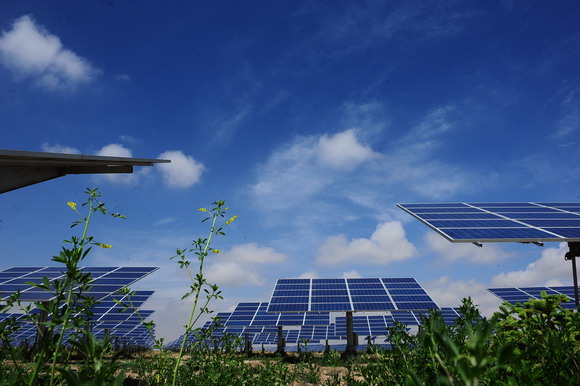 A solar power plant is pictured at the Talatan grassland in Qinghai province, June 19, 2013. [Photo / Xinhua] |
China has introduced measures to curb photovoltaic overcapacity while seeking to expand domestic demand
China has put forth new rules to tackle overcapacity in its solar power industry. A document released by the Ministry of Industry and Information Technology (MIIT) specifies the thresholds needed to enter the (PV) industry and is sure to keep plenty of capital at bay.
Under the new rules, access to the industry will be strictly controlled. For instance, investors who wish to enter the industry must now invest a minimum 20 percent of the value of the desired project. There are also minimum requirements for investment in research and development. Only a few domestic PV enterprises can meet the requirements, says Wang Yong, an analyst with CITIC Securities Co Ltd, so most small and medium-sized enterprises are likely to be washed out of the industry.
China's PV modules are mainly exported to Europe and the United States, and tax rebates are a big source of income for PV enterprises, which led to trade frictions with the above-mentioned importers. According to the new rules, however, unqualified PV manufacturing enterprises and projects won't enjoy export tax rebates or favorable support for domestic sales.
Before the MIIT released this latest document, investors had plenty of freedom to invest wherever and how much they wished in the country's solar power industry, leading to severe overcapacity and disorderly development. Wang says the MIIT's document is a late remedy but still welcome.
More M&As
According to the MIIT figures, total liabilities of China's top 10 PV enterprises have surpassed 100 billion yuan ($16.26 billion). In the first half of this year, 80 percent of PV enterprises suspended their production.
Meng Xiangan, vice-president of the China Renewable Energy Society, says in the past China's PV enterprises were desperately expanding their production capacity and seizing the market with low prices. Ninety-five percent of China's PV products are exported, but because of the anti-dumping and anti-subsidy measures adopted by the EU and the United States, such a pattern cannot be sustained and changes in the way in which the industry operates are needed.
Meng says the launch of new requirements for the solar power industry indicates that a new round of restructuring is set to begin. During this process, those enterprises with outdated technologies and a heavy debt burden may be reorganized, while those with core competitiveness will grow and become stronger.
According to a report by CITIC Securities, industrial leaders will not be affected, while small PV enterprises will likely be reorganized or acquired. Ren Haoning, a researcher of energy industry with CIConsulting, a Shenzhen-based industrial research company, says most of China's PV manufacturing enterprises are still engaged in raw material processing. For example, 50-70 percent of polycrystalline silicon products China exports to Europe and the United States are simply processed with imported raw materials. The number of polycrystalline silicon enterprises is big, but their scale is small, and only less than 10 percent of them can meet requirements specified in the MIIT's document. It is estimated that after the document comes into effect, many Chinese PV enterprises will be acquired or even shut down, which will help reduce surplus capacity.


Copyright 1995 - . All rights reserved. The content (including but not limited to text, photo, multimedia information, etc) published in this site belongs to China Daily Information Co (CDIC). Without written authorization from CDIC, such content shall not be republished or used in any form. Note: Browsers with 1024*768 or higher resolution are suggested for this site.
License for publishing multimedia online 0108263 Registration Number: 130349