Meanwhile, many environmental NGOs are struggling for survival due to financial difficulties. According to research conducted by Professor Deng Guosheng at the School of Public Policy and Management at Tsinghua University, many NGOs misused earmarked project management fees for administrative purposes, including paying for office rent and staff salaries. Many allegedly cheat in their accounting records just to make ends meet.
Deng told Beijing Review that to make China's NGOs stronger and more influential, the government should purchase more services from grassroots NGOs in order to alleviate their financial pressure and cut back on registration requirements.
Pleasing the masses
Last year, Zhang Shiyou, a farmer in East China's Anhui province, led a protest by local farmers demanding the closure of a chemical factory next to their village. He took photos of dead fish in a pond and crops dying in fields submerged by the factory's run-off. After the protest, with the help of local media organizations and environmental NGOs, the chemical factory and local government together pooled 200 million yuan to clean up the environment and compensate farmers for relocation.
|
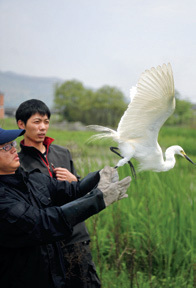 Fang Minghe (right), 28, founder of Green Eyes China, an environmental NGO, witnesses the release of an injured egret into the wild after nurturing it back to health on April 19, 2012. [Photo/bjreview.com.cn] |
 Black-necked cranes rest in a nature reserve in Ninghai county, Guizhou province, the world's largest winter habitat for black-necked cranes created jointly by the local government and NGOs. [Photo/bjreview.com.cn] |
"We are satisfied with the compensation deals, but we still worry that there could be projects with environmental hazards we don't know about," Zhang told the Xinhua News Agency. "The public wants more transparency and to have a larger part in decision making."
According to a survey by the Xinhua News Agency, environmental pollution has become one of the three major causes for protests in China together with illegal land acquisitions and labor disputes. Most protests over environmental concerns were sparked by projects being launched without approval or for failing to adequately assess their impact on local communities.
"The government will increase transparency and public involvement in decisions regarding major projects with a potential environmental impact," Minister of Environmental Protection Zhou Shengxian said at a news conference on the sideline of the 18th CPC National Congress on Nov 12.
"As China develops rapidly, it is experiencing environmental problems in a relatively short space of time that more developed economies had centuries to tackle," Zhou said.
In 2012 alone, three violent protests against the construction of chemical projects near residential areas broke out in Shifang in southwestern Sichuan province and the eastern cities of Qidong in Jiangsu province and Ningbo in Zhejiang province. All the projects were eventually scrapped.
Zhou said that central authorities require all large projects to undergo stringent risk assessments and the Ministry of Environmental Protection will work with other government agencies to ensure the rules are followed.
Liu Zhibiao, president of the Jiangsu Provincial Academy of Social Sciences, said that once a protest occurs over environmental concerns, the local government always immediately announces the abrogation of the project at stake. He warned that such practice could greatly compromise China's industrialization process.
Liu suggested that public representatives, NGOs, education programs, environmental monitors and legal agencies should be encouraged to participate in the decision-making process.
"Promoting ecological progress must rely on institutional building and we urgently need to perfect environmental decisionmaking involving public participation," said Wang Kaiyu, a sociologist from the Anhui Provincial Academy of Social Sciences.
Wang said that relationship between protests and government concessions are fundamentally attributed to the conflicts between rising public awareness and current ways that governments administrate environmental issues. He believes that governments should survey public opinion before a project is given the go-ahead and should release timely information about the current state of the environment.


Copyright 1995 - . All rights reserved. The content (including but not limited to text, photo, multimedia information, etc) published in this site belongs to China Daily Information Co (CDIC). Without written authorization from CDIC, such content shall not be republished or used in any form. Note: Browsers with 1024*768 or higher resolution are suggested for this site.
License for publishing multimedia online 0108263 Registration Number: 130349