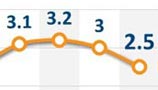
BEIJING - China's economy grew 7.4 percent in 2014, the weakest annual expansion in 24 years, but still in line with market expectations, as the country braces for a "new normal" of slower yet higher quality growth.
Last year, China's gross domestic product reached 63.65 trillion yuan ($10.4 trillion), the National Bureau of Statistics (NBS) said Tuesday. Growth in the fourth quarter came in at 7.3 percent, flat from the rate in the third quarter.
The annual reading was a touch below the government target of around 7.5 percent for the year, as authorities are at pains to shift the economy onto a more sustainable track while tackling a housing slowdown, softening domestic demand and weak global recovery.
"The economy remains steady under the 'new normal,' with positive trends of stable growth, optimized structure, enhanced quality and improved social welfare," noted Ma Jiantang, head of the NBS at a press conference.
Ma said the 7.4 percent rate is within a "reasonable range" as China's job market remains steady. In 2014, China added 13.22 million jobs, exceeding its target of 10 million.
Tuesday's data also showed China's industrial output grew 8.3 percent, down from a 9.7 percent gain in 2013, while growth of China's fixed-asset investment slowed to 15.7 percent. Retail sales went up 12 percent to 26.24 trillion yuan.
The slowing property sector was a major drag on the economy. In 2014, China's property investment rose 10.5 percent, a sharp retreat from the 19.8 percent gain seen a year earlier, and analysts largely expect the slowdown to continue this year.
"The property market will extend weak growth, and its contribution to the broader economy can hardly return to the level of previous years," said Kuang Xianming, director of the research center for economy under the China Institute For Reform and Development.
With fourth-quarter growth momentum remaining sluggish, analysts expect China's economy to slip further in 2015.
In a tone-setting economic conference in December last year, Chinese leaders stressed the economy still faces many challenges and "relatively big" downward pressures, such as increasing difficulties for businesses and the emergence of economic risks.
The statement did not give a specific growth target for 2015, which is usually made public in March, but said the government will be "reasonable" when setting goals and maintaining flexibility of its macro-control policies.
"We expect GDP growth to slow to 7.1 percent in the first quarter of 2015, given deep-rooted domestic challenges such as tighter controls over local government debt, the property market correction and deleveraging," said a Nomura report.
The World Bank predicted in its latest report that China's economy will grow 7.1 percent in 2015, 7 percent in 2016 and 6.9 percent in 2017 as structural reforms, such as a gradual withdrawal of fiscal stimulus and continued prudential measures to slow non-bank credit expansion, will weigh on growth.
Despite tempered growth, Chinese policymakers have moved more cautiously than the market expected. The central bank last November lowered the one-year benchmark lending rate by 40 basis points and the one-year deposit rate by 25 basis points, the first interest rate cuts in more than two years.
Though there has been speculation about a cut in the banking reserve requirement ratio (RRR) to free up cash to the economy, the central bank has so far refrained from doing so.
Lu Ting, chief China economist with Bank of America Merrill Lynch, wrote in a report that the much-needed monetary easing is being delayed by China's stock market rally, as policymakers are afraid that high-profile easing measures could unduly fuel the rally.
But with the A-share market hitting its biggest daily drop in 6 years on Monday, the likelihood of RRR cuts is growing rapidly, Lu said.
"Against the backdrop of an uncertain global recovery and a weak property market, we believe more aggressive monetary easing and further growth-supporting reforms will be deployed to anchor domestic demand in the coming months," wrote Qu Hongbin, chief economist for Greater China at HSBC, in a research note.

Copyright 1995 - . All rights reserved. The content (including but not limited to text, photo, multimedia information, etc) published in this site belongs to China Daily Information Co (CDIC). Without written authorization from CDIC, such content shall not be republished or used in any form. Note: Browsers with 1024*768 or higher resolution are suggested for this site.
License for publishing multimedia online 0108263 Registration Number: 130349