 |
The State Council released about 10 policies from June to August last year that collectively aimed to promote restructuring while stimulating growth.
Party chief Xi Jinping has stressed on many occasions that the government should not simply use GDP growth as the sole criterion to assess the performance of local officials. He has also said that local governments should not become obsessed with their growth rate or rank among all provinces but should instead pay more attention to green development and respect the market's role in resource allocation.
In line with the push to downplay GDP, most provinces and cities in East China (except Fujian and Tianjin) set GDP growth targets of 2014 below 9 percent, with Beijing and Shanghai as the lowest at 7.5 percent
Liu Shangxi, an economic researcher at the Ministry of Finance, said: "Most local governments lowered their growth targets not only because of the central government's emphasis on more balanced growth but also as a rational choice amid the pressure of industrial structural transformation."
An advisor to the Guangdong government, Chen Hongyu, told China Business News: "Government debt, environmental pollution and overcapacity are the headaches of the rich provinces."
China's integration into the world has meant in the past few years that international financial crises have a greater impact on the coastal provinces' trade.
Analysts said that lackluster trade conditions will persist, forcing the coastal provinces to turn to consumption and services for new growth.
Obstacles loom
But there are obstacles to overcome before tapping into China's consumption.
Household incomes account for about 55 percent of per capita GDP in moderately developed countries. But the proportion is only about 40 percent in even the richest regions in China.
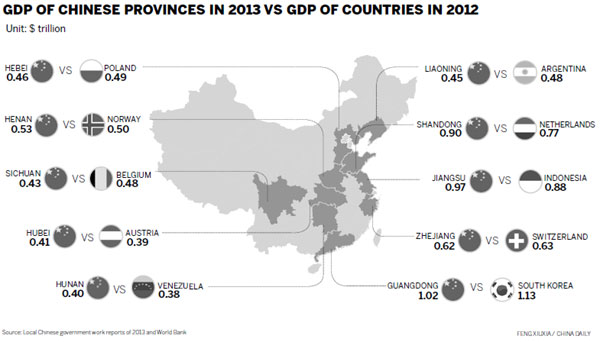
Ding Changfa, an economic researcher at Xiamen University, said the governments of the rich provinces must pay more attention to improving living standards after passing the $10,000 milestone of per capita GDP that defines a moderately developed country.
"The government should transform its role from an all-powerful authority to a public service provider," Ding said. "The government's money should firstly meet the needs of the people."
"Adding investment to established industries or starting new projects has become the fastest way to boost GDP," said Chen Yao, who studies regional economies at the Chinese Academy of Social Sciences, the top government think tank.
"These provinces have not cared about modern service sectors and innovation until recently."
Abandoning the practice of excess investment is another key task for local governments.

Copyright 1995 - . All rights reserved. The content (including but not limited to text, photo, multimedia information, etc) published in this site belongs to China Daily Information Co (CDIC). Without written authorization from CDIC, such content shall not be republished or used in any form. Note: Browsers with 1024*768 or higher resolution are suggested for this site.
License for publishing multimedia online 0108263 Registration Number: 20100000002731