Market-driven reforms
Freight transport has contributed a huge amount to railway revenues for many decades, but the volume of rail freight shrank in the second half of last year as a consequence of China's economic slowdown and fierce competition from air carriers and trucking companies, according to a source with the Kunming Railway Bureau, who spoke on condition of anonymity.
From January to April, the volume of rail freight nationwide dropped 1.5 percent compared with the same period in 2012, but the total revenue of the Chinese logistics industry rose 9.8 percent from the previous year, according to the China Federation of Logistics & Purchasing.
In March, the former Ministry of Railways was split into commercial and administrative arms, namely China Railway Corp and the State Railways Administration, which was merged with the Ministry of Transport. The CRC took on the former ministry's debts, which totaled 2.79 trillion yuan, according to a ministry audit in 2012. The optimum time for CRC to repay the debt, estimated to arrive in four or five years, also pushed the corporation to carry out market-oriented reforms to improve profitability.
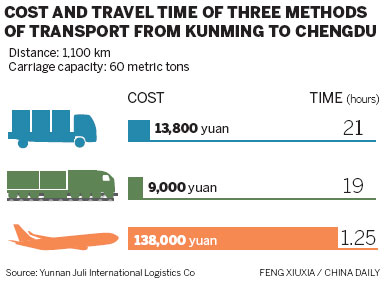
Compared with other methods of freight transport, such as air or road, the lower price charged by the railway gave it a unique advantage. Rail freight is 5 to 10 yuan cheaper per metric ton than road haulage, meaning a logistics company that carries 200,000 tons of freight annually can reduce its costs by at least 1 million yuan.
|
|
However, logistics companies complained that the cost advantage had been undermined by other charges, such as service fees, and the complicated booking procedures prior to the reform.
During the era of the planned economy, rail transport was a scarce resource and businesses had to request, or sometimes even plead, for freight to be transported. Moreover, the authorities charged a service fee of 10 to 30 yuan for each ton of freight carried, plus storage fees if clients didn't claim their goods on schedule.
"Before the reform, my company was required to submit transport plans for each week, month and season, to the railway station. It took at least 30 days to get approval for freight and there were a lot of procedures to go through, such as submitting a booking application, identifying and claiming the carriages and loading them," said Zhou Houjun, general manager of Shunhe Transport Co in Kunming, the capital of Yunnan province.
Zhou said that now, as long as the goods arrive at the railway station on time, they will be subjected to a security check and then loaded immediately. No other measures are required.
Dai Chaojian, manager of Yunnan Juli International Logistics Co, said his company used to submit preliminary plans to the railway station, clearly specifying how much freight would be transported during the next month, season and year.
"The railway was called 'Big Brother' in the transport industry, as it had a huge nationwide network. Therefore, all the goods had to be clearly listed in our paperwork. But usually only about 50 percent of the requested freight would be approved for transportation," Dai said.
After the reform, Dai noticed a huge change. "The process has been shortened and now it only takes a day to submit an application and load the goods onto the train," he said.
The improvement in efficiency means that Dai's company expects to transport 200,000 tons of freight this year, a year-on-year increase of more than 60 percent. "My company transports 30,000 tons of iron and steel every month and usually 40 percent of the total is shipped by rail. However, the proportion rose to 90 percent in July," said Dai.
For some clients, the higher price of road transport isn't an issue. "Time is crucial in the logistics industry and our clients don't care much about the extra expense of using the highway. They will lose much more if iron and steel prices surge, and they do fluctuate constantly, often by as much as 300 to 400 yuan per ton," added Dai.


Copyright 1995 - . All rights reserved. The content (including but not limited to text, photo, multimedia information, etc) published in this site belongs to China Daily Information Co (CDIC). Without written authorization from CDIC, such content shall not be republished or used in any form. Note: Browsers with 1024*768 or higher resolution are suggested for this site.
License for publishing multimedia online 0108263 Registration Number: 130349