Swiss electronic components manufacturer Huber+Suhner AG has made the single biggest investment in its history - $65 million - to establish a plant in Changzhou, Jiangsu province, producing low-frequency wire and cable products.
The products will be widely used in railway vehicles, solar technology and electric and hybrid vehicles.
Urs Kaufmann, company CEO, believes that China now possesses enough skilled engineers and researchers that it has not only become the biggest growth market, but also the powerhouse for the company.
"We believe in the growth of the Chinese market and, more importantly, customer proximity is key to our success," he says.
Confidence in China's continued rise has also attracted the manufacturing group Halma Plc, a former rubber trader with headquarters in the UK.
"I think the track record of China's strong and sustainable growth has proved China's ability and that it can and will make further progress in a more balanced way," says Martin Zhang, director and chief representative of Halma Plc in China.
The company, with expertise in electronic, health and safety and environmental technologies, acquired the Hebei-based Baoding Longer Precision Pump Co to consolidate its growth in China.
Longer Precision Pump makes syringe and gear pumps used in laboratory, medical and industrial applications.
Zhang says acceleration of the European SMEs' investment in China shows the country has created a better business environment by simplifying investment procedures and improving transparency.
It also believes the competitive edge EU companies provide matches the country's economic development plan to move up the value chain and pursue high-tech industries.
"We focus our resources in the safety, medical and environmental industries. And these markets will grow strongly in China over many years to come," Zhang says. "China needs the help from other countries for their most advanced technologies and services."
This comes at a time when a string of European conglomerates have signaled a retreat from the Chinese market, citing soaring labor and operational costs among major concerns. Sportswear maker Adidas AG, for instance, opted to relocate to even cheaper ASEAN nations for cost control.
But such costs do not worry SMEs so much. SMEs account for more than 98 percent of companies in Europe and account for 70 percent of EU jobs and GDP. More importantly, they are considered the chief source of creative ideas and technological innovation.
Pester Pac Automation identifies high-caliber skills as the most valuable resource for innovation and long-lasting business ideas.
"Unlike those bigger firms, we are not big producers in volume," says Thomas Pester. "Rather, we need a small number of highly-educated people as the good input in our business. We don't really need quantity of people but the quality and we have that in China, in Shanghai."
Similarly, Haldor Topsoe, with its new catalysts plant in Tianjin, aims to localize production as much as possible, seeking qualified industry specialists and hiring local operations teams.
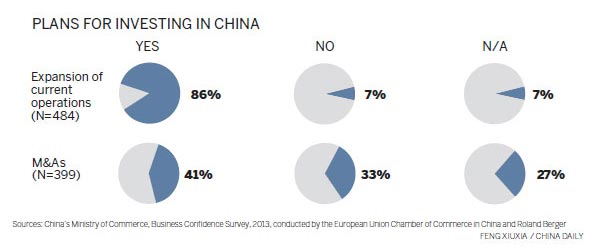
However, in a recent survey, consultancy Roland Berger Strategy Consultants found that 30 percent of 526 European firms in China mentioned high competition from privately owned Chinese companies as a key impediment to local business.
Haldor Topsoe's PR director Chang says it will be a challenge to recruit and retain local specialists as Chinese industry is continuing to improve and competition for top talent is fierce.
But the investment has been made viable, he says, thanks to a much more transparent business environment in China, where the EU has opened many contact points to give its SMEs easier access and make it more beneficial for smaller firms.
While rising labor and operation costs may still be a concern, Kaufmann of Huber+Suhner is optimistic that the value of their products with increase accordingly.
Boehringer says Shanghai was chosen to launch its joint venture with ZJ Base because of advantages in the investment environment, service system and talent resources, as well as positive feedback and support from government and regulators.
On the exit moves of some of the bigger Western companies, Dan Steinbock, research director of International Business at the India, China and America Institute, an independent think tank in the US, believes that while these companies can enjoy greater cost efficiencies by moving to emerging neighboring countries, they cannot achieve comparable scale and scope. Nor would they benefit from comparable infrastructure and logistics.
"As the Chinese economy is moving from a tangible, asset-based economy to an intangible and value-added one, the size of FDI means much less today than its composition," he says.
Robert Theleen, chairman of the American Chamber of Commerce in Shanghai, points out that before China's rise, the successful Asian countries were either an island (Japan), peninsula (South Korea) or city state (Singapore). But China is the first nation to industrialize rapidly that is similar in size to a continent. That requires it to think "horizontally", he says.
Unlike many smaller markets that have only one scale of competitiveness and develop vertically, China has plenty of scope for sustainable growth from its coastlines and inland and may well leverage comparative advantages across different regions and cities.
According to Tim Lyons, general manager of Manage China, an Australian-invested business process outsourcing firm, China's edge is through clear government direction, outlining key industries to ensure people continue investing.
"It is no longer a black-and-white situation where foreign companies prefer the market access or the cost advantage," he says. "It is more of an overlap of labor, high technology as well as owning brands."
China's supply chain has grown rather sophisticated and, even if some firms move out, they choose to maintain a relationship that may prove valuable and useful in the future.
But experts say the Chinese government still has a way to go to convince companies that they can move inland in China rather than leaving the country.
"It is still problematic because many inland cities are not perceived as pro-business, because of lack of regulation and higher logistic costs," says Pedro Videla, professor of economics at IESE, the graduate business school of the University of Navarra in Barcelona.
Another thing the government can do is to clear investment hurdles by lowering thresholds in industries such as telecoms and finance, which are held by domestic monopolies.


Copyright 1995 - . All rights reserved. The content (including but not limited to text, photo, multimedia information, etc) published in this site belongs to China Daily Information Co (CDIC). Without written authorization from CDIC, such content shall not be republished or used in any form. Note: Browsers with 1024*768 or higher resolution are suggested for this site.
License for publishing multimedia online 0108263 Registration Number: 130349