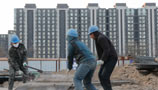
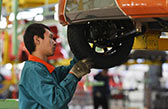
The government has introduced the strategy at a time when economic crises in Europe and the United States have caused a continuous decline in overseas demand for Chinese goods, and as the authorities seek a solution to the overcapacity that afflicts the manufacturing sector.
In the meantime, the migrant worker population hit 262.61 million in 2012, according to the National Bureau of Statistics. If such a large number of people were to be reclassified as city residents the subsequent upsurge in demand would be huge.
"Urbanization is the key to China maintaining economic growth and 'soft-land' its economy," said Wen Tiejun, dean of the school of agricultural economics and rural development at Renmin University of China.
Chi Fulin, president of the China Institute for Reform and Development, said urbanization will accelerate the transformation of the economy from an export-driven model to one based on domestic consumption. If successful, the move could sustain GDP growth of 7 to 8 percent in the coming decade.
Planners will encourage urban agglomeration, gradually reclassify migrant workers as urban residents and promote equal access to basic public services. They will also coordinate the development of different-sized cities and small towns, and increase the urban population capacity by strengthening the economy, infrastructure, natural resources and environments in the cities.
During this year's meetings of the National People's Congress and the Chinese People's Political Consultative Conference, local officials eagerly promoted the construction of city clusters, such as Chengdu-Chongqing in Southwest China, where large urban areas in close proximity employ increased collaboration between local governments, and combine the use of resources. Some of these clusters are huge; one example is the urban sprawl in the middle reaches of the Yangtze River where 40 cities, with a total combined area of nearly 440,000 square kilometers, house approximately 160 million people.
A convoluted history
The story of urbanization is long and convoluted and has suffered at least three major twists since the New China was founded in 1949.
During the First Five-Year Plan (1953-1957), China started 156 industrial construction projects with the aid of the former Soviet Union, and a large number of farmers swarmed to the cities. But in the early 1960s, many factories were closed or merged as a result of natural disasters and poor planning and policies, and the urbanization process suffered a major setback.
Another unexpected phenomenon was that of the "sent-down youth", when Chairman Mao Zedong ordered young city-dwelling intellectuals and recently graduated middle-school students to move to the countryside and "learn from the farmers".
The most recent setback occurred during the 2008-09 global financial crisis. As export orders fell sharply, many companies ceased, or partially suspended, production. At least 20 million migrant workers lost their jobs and returned to their home villages.
Urbanization was considered a major driving force for economic development and was listed as a national strategy in the 10th Five-Year Plan (2001-05), which emphasized that raising the levels of urbanization and boosting rural-urban migration would optimize the economic structure and create virtuous cycles of sustainable socioeconomic development.


Copyright 1995 - . All rights reserved. The content (including but not limited to text, photo, multimedia information, etc) published in this site belongs to China Daily Information Co (CDIC). Without written authorization from CDIC, such content shall not be republished or used in any form. Note: Browsers with 1024*768 or higher resolution are suggested for this site.
License for publishing multimedia online 0108263 Registration Number: 130349