Comments
  Print
Print  Mail
Mail  Large Medium Small
Urbanization: Qualitative, rather than quantitative, say experts
|
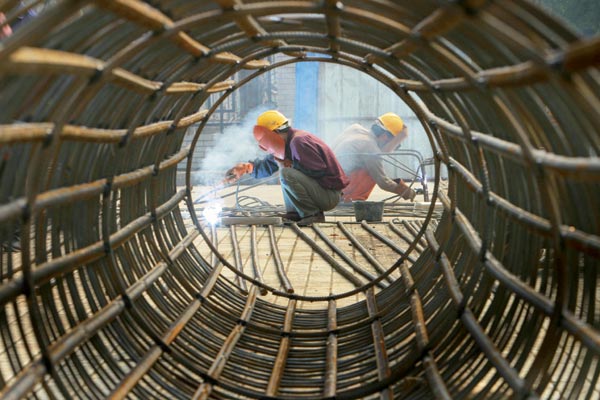 Workers at a construction site in Nanjing, Jiangsu province. The biggest challenge for policymakers is to make urbanization "human-centric". Provided to China Daily |
Urbanization is still an integral element of China's growth agenda and policymakers should strive to push for steady, gradual results, rather than quick solutions, experts say.
Two key meetings in 2013 have dispelled much of the doubts about the direction of urbanization in China and the approach of policymakers toward the emerging engine for economic growth.
During the Third Plenum of the 18th Central Committee of the Communist Party of China in November, policymakers fired the first salvo by indicating that they would reform the existing household registration (hukou) system and ease the rules for small and medium-sized cities. Policymakers also said they would cap the population flows to big cities.
The Central Urbanization Work Conference held last month had a more detailed plan for urbanization. Urbanization is a natural and historical process. The targets should be practical and realistic, it said. Officials should not pursue quick results, but instead push forward urbanization in an "active and steady manner".
Guan Qingyou, assistant dean of the Minsheng Securities Research Institute, says that policymakers have clearly indicated that urbanization needs to be more qualitative, than quantitative.
"Local officials and real estate developers should no longer see urbanization as an opportunity to boost infrastructure or for quick development. This is a denial of the 'city construction' mentality," he says.
Premier Li Keqiang, who has championed the strategy since 2012, had earlier stressed on several occasions that "urbanization" is China's "biggest domestic demand" in the future, as the country seeks to shift its economy away from investment and exports-led to one driven by domestic consumption.
But last year Li indicated that China should also "manage the pace and quality" of urbanization. Along with population migration, industries should also be helped to create enough jobs, the premier said. He added that the focus should be on creating ecologically friendly and energy-efficient industries.
Experts say Li's statements were a reminder to local officials not to rush in with big-ticket infrastructure or property projects in the name of urbanization.
That caution has since found its way into the December document on urbanization. In addition, routine talk of the economic dimension of the urbanization, the 3,000-word document has a considerable section devoted to social, environmental and city planning. For instance, the document urges efficient use of urban land, increasing population density in built-up areas, raising energy efficiency and reducing energy and carbon dioxide intensity.
Hu Cunzhi, vice-minister of land and resources, says the built-up areas of China's cities have expanded drastically by 83.4 percent between 2000 and 2010, while the decade witnessed 45 percent growth in urban population.
Even more startling was the stipulation that city planning should integrate nature into the urban landscape to the extent that city residents should be able to "see the mountains, watch the water and remember their nostalgia" - poetical language rarely seen in official documents.
Copyright 1995 - . All rights reserved. The content (including but not limited to text, photo, multimedia information, etc) published in this site belongs to China Daily Information Co (CDIC). Without written authorization from CDIC, such content shall not be republished or used in any form. Note: Browsers with 1024*768 or higher resolution are suggested for this site.
License for publishing multimedia online 0108263 Registration Number: 20100000002731