Comments
  Print
Print  Mail
Mail  Large Medium Small
Welcome to Beijing.
The slogan used to greet visitors during the 2008 Olympics lost some of its luster if you traveled to the capital in the last few days of the National Day holiday.
From Thursday to Sunday, the city was shrouded in the heaviest smog in months, and neighboring Tianjin municipality and Hebei province were no exception.
 |
|
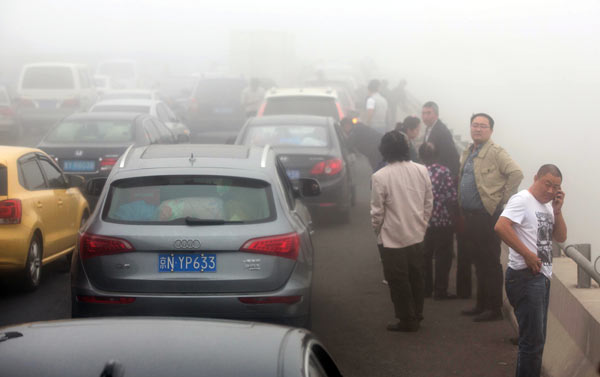
People are left waiting on an expressway in Weifang, Shandong province, after a series of collisions blocked the road on Monday amid heavy haze. Smog shrouded North China in the last few days of the weeklong National Day holiday. Mao Yanzheng / China Daily |
|
Related: |
"It's completely different from the golden autumn that I had expected in Beijing," said Wang Zhidong, a 37-year-old tourist from Tianjin who visited the capital during the holiday.
The pollution also reduced visibility, causing traffic congestion on expressways and flight delays.
The Beijing Environmental Protection Bureau said high humidity and lack of wind were the major reasons for the haze.
Yu Jianhua, who is in charge of air pollution management at the bureau, said the size of the city and the fact that it is ringed on three sides by mountains has made it hard to disperse pollutants.
Beijing has been hit frequently by smog in recent years. The city had 14 smoggy days from Sept 1 to 28, about 10 more than the average in the same period for the past 20 years, according to the China Meteorological Administration.
Pollutants emitted by cars are the major cause of the smog. Coal consumption in neighboring regions and dust from construction sites also contribute, according to the Beijing Environmental Protection Bureau.
Car emissions have become a major source for air pollution in big cities, accounting for 58 percent of the nitrogen oxide, 40 percent of the volatile organic compounds and 22 percent of fine particles in Beijing's air, according to the Ministry of Environmental Protection.
To tackle pollution caused by vehicles, a senior ministry official has suggested the government collect a fee from heavy-polluting vehicle owners, rather than giving out subsidies to phase out such vehicles.
"It is questionable issuing subsidies to the polluters by using money collected from everyone through taxes, which is against the basic concept of ‘holding those who cause pollution responsible for clearing it up' in environmental protection," said Ding Yan, deputy head of the ministry's vehicle emission control center.
As many as 15 million yellow-label cars — those that do not meet the phase 1 emission standards — will be removed from the roads nationwide by 2017, according to the Airborne Pollution Prevention and Control Action Plan (2013-17) unveiled by the central government last month.
Pollutants emitted by one yellow-label car equal the amount from 28 vehicles meeting phase 4 emission standards. They account for about 10 percent of the vehicles being used yet discharge 50 percent of the pollutants coming from automobiles, according to the ministry.
But removing them from the streets is no easy task. Policies in the past almost all saw subsidies from local governments to encourage yellow-label car owners to abandon the old cars.
Ding said the most rational move is to collect fees from yellow-label car owners, and use the fees to accelerate the upgrade of emission standards.
The plan also requires major cities such as Beijing, Shanghai and Guangzhou to strictly control the number of vehicles.
China has been the world's top automobile producer and seller for four consecutive years. During that period, the number of light motor vehicles has grown 20 percent every year, reaching 82 million at the end of 2011.
The total number of motor vehicles in China will reach 590 million by 2050, according to research by Tsinghua University.
"To ‘strictly control' does not mean to stop developing the industry, just a restriction to the pace," said Ding, adding that Beijing's annual growth in the number of vehicles was reduced from 800,000 to about 200,000, after the local government started to restrict the issuing of license plates.
The capital vows to keep the number of private cars to less than 6 million by the end of 2017, as compared with more than 5.2 million in early 2013.
Contact the writers at wuwencong@chinadaily.com.cn and zhengxin@chinadaily.com.cn.
 4th World Internet Conference concludes
 Starbucks Reserve Roastery set to open in Shanghai
 Smile to get discounts in Tmall's unmanned supermart
 Top 10 richest Chinese women in 2017
 World leading internet sci-tech achievements released in Wuzhen
 Top tech CEOs take to the stage as Wuzhen Summit opens
 Major topics at 4th World Internet Conference
 'Made in China' dinosaurs amuse the world

Copyright 1995 - . All rights reserved. The content (including but not limited to text, photo, multimedia information, etc) published in this site belongs to China Daily Information Co (CDIC). Without written authorization from CDIC, such content shall not be republished or used in any form. Note: Browsers with 1024*768 or higher resolution are suggested for this site.
License for publishing multimedia online 0108263 Registration Number: 20100000002731