Xi to explain economic priorities in Davos


 |
|
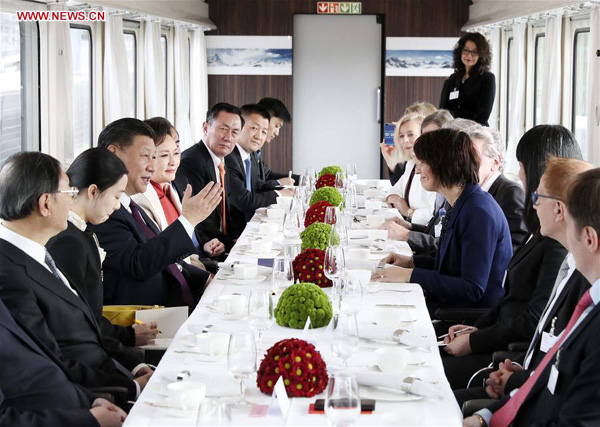
Chinese President Xi Jinping and his wife Peng Liyuan enjoy tea and conversation with Swiss President Doris Leuthard and her husband Roland Hausin in a special train on their way to Bern, capital of Switzerland, Jan 15, 2017. [Photo/Xinhua] |
During his visit to Switzerland from Sunday to Wednesday, President Xi Jinping will attend the World Economic Forum annual meeting in Davos and deliver a speech at the United Nations main office in Geneva. The Davos meeting, usually attended by China's premier and vice-president, will witness for the first time a keynote address by China's head of state. Xi is expected to explicitly explain his views on the global economic landscape and China's solutions to global problems at the gathering.
Xi's trip, the first state visit by a Chinese leader this year, comes at a time of uncertainties amid rising anti-globalization, protectionism, isolationism and populism even in economies such as the United States and the European Union that have for decades advocated free trade. The election of Donald Trump as US president and the rise of anti-establishment forces in Germany and France, the EU's heartland, do not bode well for the already wobbly global economic growth.
In sharp contrast to the gloomy prospects of the world economy and international relations, Beijing remains committed to globalization. And Xi's presence at the Davos meeting is a reflection of China's determination to press ahead with the multilateral economic system. His presence at Davos also highlights the fact that China is willing and has the capability to set globalization on a more synergistic, inclusive course.
In May, China will hold a high-level international cooperation forum on the Belt and Road Initiative that focuses on global recovery, re-balancing, renovation and reconnection in response to rising concerns over global governance. Proposed in 2013 and unlike traditional globalization backed by tariff reduction, the Belt and Road Initiative (the Silk Road Economic Belt and 21st Century Maritime Silk Road) is aimed at improving connectivity between regions and boosting global growth, through infrastructure construction among other things.
The Belt and Road Initiative, which focuses on Eurasian infrastructure and better land and sea connectivity, is expected to elevate 3 billion more people to the middle class by 2050 and help increase global trade by $2.5 trillion in the next decade.
The initiative has good reasons to achieve its targets, because every $1 increase in infrastructure investment in developing economies can raise their imports by $0.7, half of which comes from developed countries, as Justin Yifu Lin, former vice-president of World Bank, has said. In other words, the West, too, can benefit from the increase in exports as the Belt and Belt Initiative stimulates global infrastructure investment.
Xi's visit to Switzerland will also witness the signing of a memorandum of understanding on the Belt and Road Initiative between China and the World Health Organization in Geneva, giving fresh impetus to the Beijing-proposed project. Cooperative deals with similar focus have been signed between China and the UN, boosting the international support for the initiative's security and long-term development.
For example, the UN resolution on Afghanistan passed two months ago specifically extended the world body's support for the Belt and Road Initiative, and encouraged all member states to take part in it to restore the war-torn country's economy.
That the Belt and Road Initiative is gaining wider support reflects Xi's foresight that it will promote deeper and more balanced regional cooperation, and allow more people, especially in the South, to enjoy the dividends of economic growth. With China remaining a trustworthy engine of global growth, the countries along the initiative's routes can expect better benefits from China's renewed endorsement of globalization.
The author is a professor at Renmin University of China and a senior research fellow at the Center for China and Globalization in Beijing.
- China seen leading on global issues at Davos
- Foreign media on Xi's attendance at Davos
- President Xi to deliver keynote speech in Davos
- Bone-chilling winter from Berlin to Davos causes energy scramble
- Davos elite face cold reality of economic task
- Xi expected to bring a steady voice to Davos
- Xi's Davos speech will 'highlight China's positive global role', WEF chief says