Davos elite face cold reality of economic task


 |
|
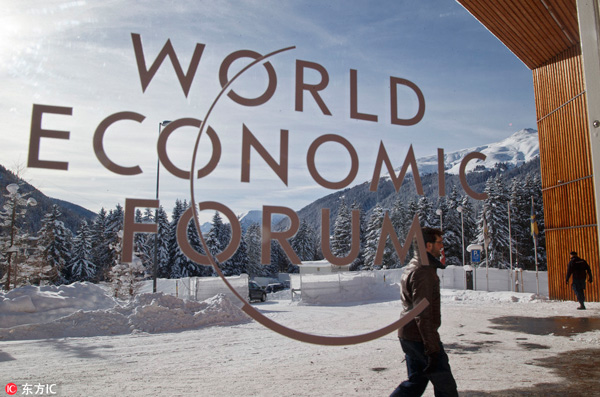
A man walks at the main entrance of the congress center where the World Economic Forum takes place in Davos, Switzerland, on Jan 18, 2016. [Photo/IC] |
More than 2,500 political and business leaders are swarming into the small Alpine town of Davos, Switzerland-and it isn't for the skiing. They're looking for solutions.
They will discuss how to push globalization at a time when it's challenged by rising populist and protectionist forces, which have been buoyed by the United States presidential election victory for Donald Trump, who will be sworn in on Friday, the same day the World Economic Forum is scheduled to conclude.
Visiting the Davos Congress Centre on Saturday, three days before the opening of the annual meeting, I saw workers busy making final preparations-in cold, heavy snow-to improve the infrastructure and logistics. It's a good metaphor for the current condition of the world economy, which is trying to fill its loopholes amid chilly growth prospects and challenges such as segmentation and the development gap.
The world economy has achieved significant growth in the past decades, with emerging-market economies gradually replacing developed ones to become engines for growth. However, growth seems to be an ever more daunting challenge, as most economies are short of solutions to sustainable growth at a decent rate.
The year-on-year growth of the world economy in 2016 was 2.4 percent and, according to the World Bank, it could rise moderately to 2.7 percent this year. Despite the increase, it's obvious that the world economy remains trapped in a low-rate growth cycle eight years after the global financial crisis. In 2006, the world economy expanded at a handsome 4.4 percent.
Worse is that decades of growth has improved the economic strength of some less-developed countries, but also widened disparity and income gaps among different groups of people, the root cause of the current surge in populism.
The world's overall Gini coefficient, which measures income equality, has hovered at around 7 percent, well above the widely accepted warning line of 6 percent. If the world economy continues on such a growth mode, there will only be more voices of discontent.
President Xi Jinping will call for "inclusive globalization" in his speech at the opening of the Davos forum on Tuesday. Such a philosophy, if truly embraced by world leaders, will serve to combat the protectionism that risks dividing the world economy and deserves the attention of elite political and business figures.