Sinochem sees innovation as key to reform


 |
|
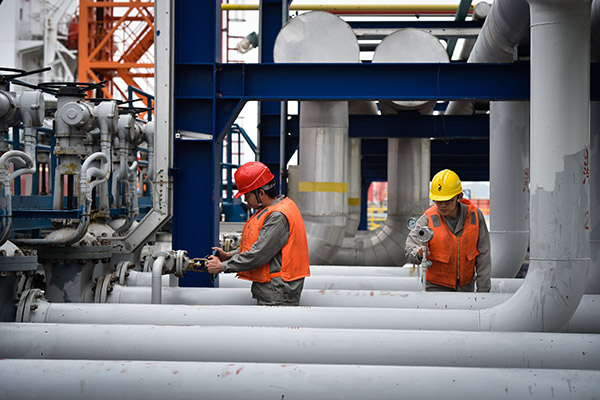
Employees from Sinochem check pipe facilities at Quanzhou Port, Fujian province. [Photo/Xinhua] |
Sinochem Group, a key State-owned conglomerate involved in energy, agriculture, chemicals, real estate and financial services, will engage in innovation-driven reform to meet the needs of China's supply-side structural reform, said its senior executives.
"While focusing on our major business in energy and chemicals, we will also keep exploring different sectors including agriculture, real estate and finance," said Ning Gaoning, Sinochem's chairman.
"Driven by innovation, the group will enhance its research and development and promote the upgrading of China's energy chemical industry, as well as deploy more resources to develop new materials for producing new energy vehicles," said Ning.
The group earned a profit of 10.4 billion yuan ($1.57 billion) between January and August, hitting a record high, thanks to its fast-growing businesses in fertilizer, seeds, pesticides, new materials and other chemical products in both the domestic and global markets.
According to Ning, supply-side structural reform is and will remain Sinochem's guiding principle in State-owned enterprise reform.
In its energy sector, the group will keep cutting excess production capacity and adjust its production volume according to market demand. Meanwhile in the fine chemical sector, the group will focus on the development of new materials with lower costs and become less dependent on imports.
Another key part of the group's reform is to optimize its resources and restructure its departments to ensure greater efficiency. It has already closed 56 departments and lowered the headcount at its headquarters by 32 percent since the SOE reform started.
In the meantime, Sinochem has established five pillar businesses in energy, chemical engineering, agriculture, real estate and finance to further compete with other established global rivals such as Dow DuPont Co and Bayer AG.
The Beijing-headquartered company is also progressively engaging in the going global strategy not only for growth potential but also for securing the country's energy security by importing crude oil, according to Zhang Wei, the group's general manager.
"We have invested significantly overseas to end the era when we were largely dependent on imports," said Zhang, "It is a matter of the country's energy security."
More than 60 percent of the group's assets are located in overseas markets such as Brazil, the United States, Europe and Africa. Sinochem has also invested in shale oil and gas in the US in recent years to acquire more mature experience, as well as seeking opportunities to acquire quality manufacturers and cooperate with energy companies in Europe and South America over the past three years.
Zhang said the group will further enlarge exports including pesticide and rubber to the economies involved in the Belt and Road Initiative, especially in Southeast Asia and Africa.
The Belt and Road Initiative has brought growth opportunities for the group. For instance, its petrochemical plant in Quanzhou, Fujian province, imports more than 10 million metric tons of crude oil annually from oil-producing countries and regions related to the initiative, while it exports around 70 percent of its refined oil to such economies.
He Jingtong, a professor of trade at Nankai University in Tianjin, said Sinochem's moves are helpful to secure ownership of more industrial and energy companies overseas, and further cast off the constraints on domestic production and dependence on imports, especially for high-end chemical and petrifaction technologies and products.
"Deepening SOE reform is also critical in cutting industrial overcapacity. Such reforms are helpful in improving SOE governance in accordance with market rules, letting market forces play a fundamental role in allocating resources," he said.