China mulls fossil fuel car ban, boosts electric vehicles


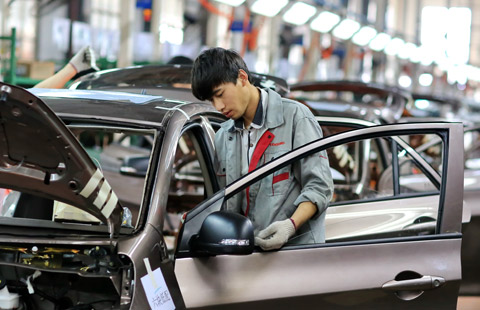
BEIJING - China is gearing up to join France and Britain to ban gasoline and diesel cars, a move that would boost new energy vehicles (NEVs) and could change the auto industry forever as the world's largest car market.
Xin Guobin, China's vice-minister of industry and information technology told an automobile forum over the weekend that China had started research on a timetable to phase out manufacturing and sales of fossil-fuel powered cars.
Though giving no details on the time frame, Xin said "the measures would surely bring profound changes to the sector's development."
"Enterprises should strive to improve the level of energy-saving for traditional cars, and vigorously develop NEVs according to assessment requirements," he said.
An inevitable future trend
The statement followed similar moves by several countries to end the era of gas-powered vehicles to cut emissions and reduce pollution.
In July, French Ecology Minister Nicolas Hulot announced that France would end sales of petrol and diesel vehicles by 2040 as part of the country's plan to meet its targets under the Paris climate accord.
The same month, the British government followed suit with a similar plan eyeing 2040 as a deadline to stop sales of new fossil fuel cars.
"In the 21 century, NEVs surpassing traditional fuel cars is an inevitable future trend," said Yang Yuwei, technology department manager of Beijing Electric Vehicle Co, adding that "For one thing, it is doubtable whether fossil fuel could last till the end of this century; for another, nowadays customers expect their cars to be intelligent, internet accessible and entertaining, and it is easier to realize these functions in NEVs than in traditional ones."
Analysts say that while there is little doubt that NEVs will eventually prevail, how long the switch takes remains to be seen and depends a lot on infrastructure and technology improvements as well as how fast automakers can adapt.
"There are still many technical difficulties to overcome, such as batteries, engines, intelligence, lightweight operating and internet connectivity. Besides, charging piles and other infrastructure need to be improved to accelerate the adoption of NEVs," said Yang.
Race for electric vehicles?
"Each area in the world has its own advantage in terms of developing NEVs. East Asia is a leader in battery technology; European countries have an advantage in engines; the United States boasts advanced electronic control technology," said Yang.
Although Europe has taken a slew of measures to promote NEVs, the output and the number of vehicles per household fail to meet the public's expectations. In contrast, NEVs have gained more popularity in China and the United States. US star enterprises like Telsa play a significant role in boosting electric vehicles.
China passed the United States last year as the world's biggest electric car market. Last year, China sold 507,000 NEVs, an increase of 53 percent year on year. Sales of pure electric vehicles surged 65.1 percent year on year to 409,000, accounting for 80 percent of new energy vehicle sales.
"Many Chinese new energy automobile companies have manufactured electric cars that have a range of over 300 km. BAIC Group produced 400-km-range NEVs this year and will probably promote those of 500 km in the future," said Yang.
"Once exceeding 500 km, the range of NEVs won't be a limiting factor. Manufacturers will not pursue long-range cars given costs and customers' requirements," he added.
China now leads the world in NEV development. Chinese auto companies including BYD, BAIC and Geely ranks among the top brands worldwide in terms of electric car sales last year, according to the China Passenger Car Association.
German car maker Volkswagen, the world's largest by sales, plans to invest a total of 20 billion euros ($24 billion) by 2030 in electric mobility and 50 billion euros in batteries.
German luxury carmaker BMW has decided to manufacture its purely electric-powered Mini in 2019.
France's PSA Peugeot Citroen announced it would promote seven kinds of hybrid electric vehicles and four kinds of purely electric cars from 2016 to 2021.
Japan's Honda plans to stop manufacturing gasoline and diesel vehicles in 2050 and devote itself to developing hybrid electric vehicles, fully electric vehicles and fuel-cell cars.