NDRC: Market forces will shape debt-to-equity swaps


 |
|
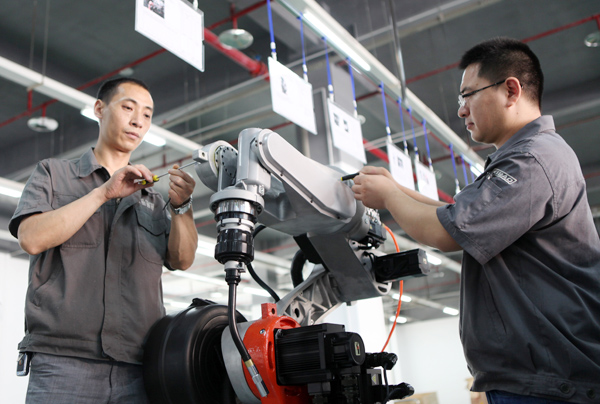
Two technicians adjust a robot at a high-tech enterprise in Chongqing. CHEN SHICHUANG / FOR CHINA DAILY |
Official rules out coercion but says troubled firms will be persuaded to consider the alternative option
China will stick to market-based principles while promoting debt-to-equity swaps to tackle debt problems of companies, an official of the nation's top economic regulator said on Wednesday.
"The government will encourage debt-to-equity programs but won't force companies and creditors to make swap deals," said the official with the National Development and Reform Commission, who sought anonymity.
Debt-to-equity swaps will be key to lowering corporate debt levels, and are expected to gather pace in the future with improved regulation, the official said.
China unveiled guidelines for such swaps late last year to help companies reduce their mounting debt.
From December to July, more than 70 enterprises in certain sectors riddled with overcapacity signed agreements to launch the swaps, according to the commission.
That would allow banks holding debt in those enterprises to convert it into equity.
Total contract value of such swaps has already exceeded 1 trillion yuan ($149.4 billion), according to the NDRC.
More than 50 percent of the enterprises that opted for swaps are coal producers, followed by steel, transportation and metal companies, according to a report by China Orient Asset Company released in July.
"Debt-to-equity programs work well for companies that are facing short-term obstacles but are expected to see profits in the future," said Xu Gao, chief economist with China Everbright Securities. "The key is to ensure the programs can be implemented using legal means and with high transparency."
Li Peijia, a senior analyst with the research institute of Bank of China, said such efforts will help banks solve the bad debts problem, but the government may need to offer more incentives to promote swaps deals.
The government is able to provide more policy supports such as helping banks to improve risk management and gather information to select proper candidates for swaps offered by many debtladen companies, Li said.
As more good examples emerge, more banks and investors are expected to participate, she said.
With enhanced efforts to rein in debt risks, corporate debt levels have declined this year, according to the NDRC.
By the end of June, the debt-to-asset ratio of China's major industrial enterprises stood at 55.9 percent, down by 0.8 percentage points compared to the same period last year, the latest data from the National Bureau of Statistics showed.