China makes strides in ecological progress in past five years


BEIJING - "Clean water and lush mountains are priceless assets." This philosophy for green development proposed by Chinese President Xi Jinping is changing the country.
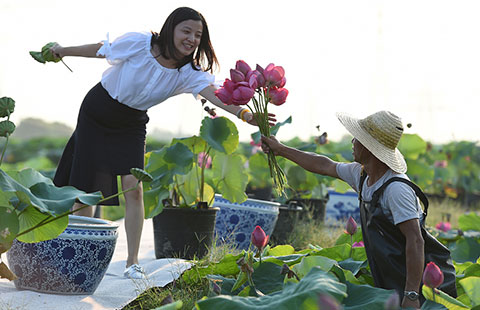
Tourists who visit Houwu village near scenic Mogan Mountain in East China's Zhejiang province often meet a foreign woman riding a bicycle across the village and picking up garbage along the road or from the river.
The British woman, Tori, is a "river chief" appointed by the local government to encourage local people and visitors to protect the environment.
Mogan Mountain has drawn loads of tourists, along with plenty of garbage, to the village as more B&Bs open. Tori collects trash when walking around town, and more villagers have joined the campaign.
"They have realized that their business depends on a good environment," Tori said.
Tori is one of tens of thousands of river chiefs, most of whom are local officials, who protect the environment along rivers in China.
The river chief system is among the major innovations in promoting green development by the Communist Party of China (CPC) Central Committee with Xi Jinping as the core, since the 18th CPC National Congress in 2012.
The report delivered at the 18th CPC National Congress included ecological development as a major task in the country's overall plan and proposed building a "beautiful China" as a grand goal for ecological progress.
Eco-civilization was also included in the CPC Constitution as a principle for development during the meeting. It was the first time in the world a ruling party had highlighted green development in its guidelines.
Xi has frequently mentioned the importance and urgency of environmental protection and green development in his speeches.
Decades of rapid growth have left parts of the country saddled with smog and contaminated soil.
"Much has been left undone in ecological protection. We will pay a higher price if we do not prioritize the work now," Xi, also general secretary of the CPC Central Committee and chairman of the Central Military Commission, said during his first inspection trip after taking helm of the CPC.
"In ecological protection, we should have the big picture in mind and take a long-term and holistic view. We should not lose the greater for the less nor attend to one thing and lose sight of another, live beyond one's means nor seek quick success and instant benefits," Xi said.
China's efforts to promote green development have earned global recognition. The United Nations Environment Programme (UNEP) decided to promote China's philosophy of ecological progress in February 2013 and released a report on China's strategies and practices in the field two years later.
Green development is not an empty idea in China. The central authorities have introduced enforcement systems to ensure local governments "walk the talk."
China introduced action plans to fight air, water and soil pollution and rolled out its harshest-ever environmental protection law. The country also decided to draw red lines declaring certain regions under mandatory and rigorous protection.
Local government efforts to promote ecological progress will be reviewed annually, then again every five years, and be used as a criterion for the promotion of officials.
In one recent case at the Qilian Mountains national nature reserve, on the border of Gansu and Qinghai provinces, senior officials, including the vice governor of Gansu province, were held accountable for their failure to prevent and investigate environmental issues. They have been urged to learn a lesson from the incident.
"No one should step beyond the prescribed limit in ecological protection, or he will be punished," Xi said.
A national campaign to review local governments' environmental protection work started in late 2015 from Hebei province and has covered 23 provincial regions. Over 6,000 officials were held accountable for negligence or malpractice in 2016.
The efforts have paid off. The average annual density of fine air particulate matter, or PM 2.5, which is often used as a gauge for air pollution, dropped by 33 percent in 2016 in the Beijing-Hebei-Tianjin region compared with 2013.
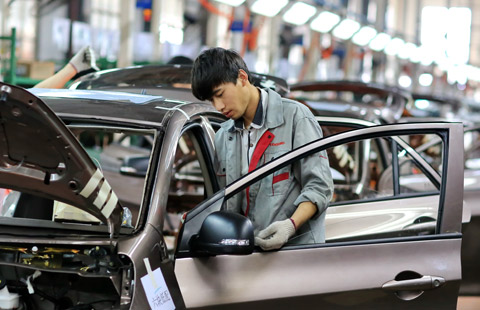
From new energy vehicles to bike-sharing, low-carbon lifestyles are becoming popular among Chinese people.
"We should stick to a green, low-carbon and recycling development path, build green sectors and promote green production patterns and lifestyles to achieve harmonious growth between man and nature," Xi said.