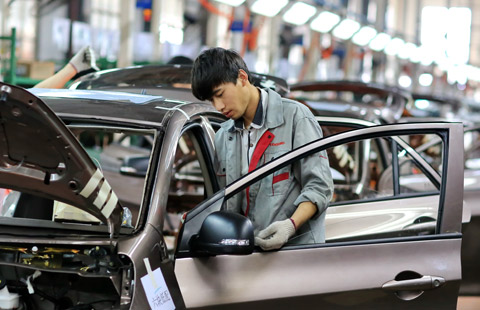
Inclusive growth increases employment


BEIJING - Every work day, rain or shine, fast-food couriers shuttle through the streets of downtown Beijing, delivering lunches and dinners for white collar workers, and their presence is ever increasing.
The catering industry creates at least 1.6 million jobs nationwide every year, according to industry insiders. The number will be much bigger considering new employment in catering-related sectors such as couriers. This new growth, including new industries and business models, contributed around 70 percent of all new jobs created in the country's cities last year, official data showed.
In recent years, China has seen more than 13 million new jobs created for urban residents each year, with the country's registered urban unemployment rate at around 4 percent.
To ensure stable employment, China has rolled out an array of pro-employment policies for graduates, the redundant, the disabled and migrant workers, while the country's entrepreneurial wave has helped fuel job creation.
At the opening ceremony of the Annual Meeting of the New Champions 2017, also known as Summer Davos, Chinese Premier Li Keqiang said that employment was always a development agenda priority, as it was fundamental to inclusive growth.
In the past three years, the number of market entities in China increased by a daily average of 40,000.
"This is a remarkable achievement for a developing nation with more than 1.3 billion people, and it is also an important contribution to world inclusive growth," the premier said.
Robust economic development has contributed to improving China's international competitiveness. The ascent of the country's global competitiveness was reflected by a report published by the International Institute for Management Development (IMD) business school in Switzerland.
China was rated the 18th most competitive among 63 economies in 2017, compared with 25th in 2016, according to the IMD World Competitiveness Yearbook 2017.
Among the four competitiveness factors in the yearbook, China ranked second in "economic performance." China also topped the three sub-indices of "domestic economy", "employment" and "labor market."
The indicators that stood out among the most improved economies were related to government and business efficiency as well as productivity, and these economies "have maintained a business-friendly environment that encourages openness and productivity," said Arturo Bris, director of the IMD World Competitiveness Center.
"If you look at China, its improvement of seven places to 18th can be traced to its dedication to international trade. This continues to drive the economy and the improvement in government and business efficiency," he said.
The view was echoed by Wang Changlin, deputy director of the Academy of Macroeconomic Research, who said that the competitiveness of China mainly came from steady economic growth and employment driven by innovation and entrepreneurship.
Thanks to supply-side structural reforms to create new sources of growth, the Chinese economy is steadily shifting from investment-fueled growth toward a growth model that draws strength from consumption, services and innovation.
Pan Jiancheng, an official with the National Bureau of Statistics, said economic growth was better than expected and more optimized in structure in the first half of the year, with indicators pointing to solid growth, increasing jobs, stable prices and a sound balance of international payments.
Both the industrial and service sectors are improving, while consumption has become a major engine for growth, suggesting the "inherent momentum" of the economy had been enhanced, Pan said.
Consumption contributed 77.2 percent to economic growth in the first quarter, up from 64.6 percent the prior year. Services contributed 61.7 percent of Q1 GDP. High-tech industry's value-added output for January-March increased 13.4 percent, according to official data.
While steady employment pointed to an optimistic economic outlook, challenges remain.
There are both quantitative and structural problems. On the one hand, more than 15 million people, including nearly 8 million college graduates, will enter the job market this year. On the other hand, technical and skilled workers are badly needed.
Authorities should step up policy support, including further tax cuts while allocating more subsidies to small and medium enterprises, which provide more than 75 percent of urban jobs, said Zhou Tianyong, professor at the Party School of the Communist Party of China Central Committee.