Phone users get handy power fix


 |
|
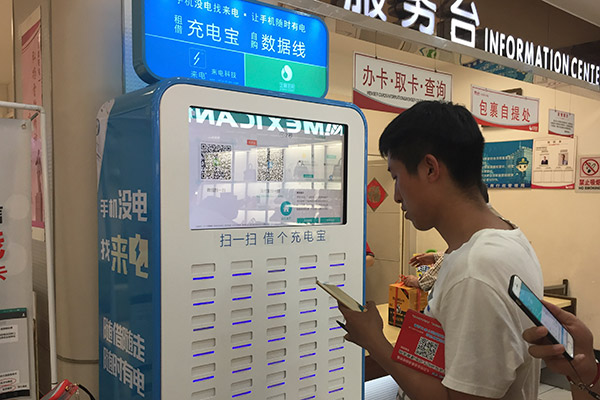
A customer tries a shared power bank at a shopping center in Jinan, Shandong province. [Photo/China Daily] |
Recharging service now in restaurants, shopping malls and even metro stations
Ubiquitous social networks, online shopping and mobile games are keeping smartphones constantly busy but they are also draining their batteries. Now, however, that need seems to have been taken care of.
According to companies behind the initiative, people can now rent a power bank to charge their mobile phones, and they are becoming almost as commonplace in public as shared bicycles.
The power bank rental service companies say their mobile chargers are usually placed in boxes at tables in restaurants or in cabinets in shopping malls, office buildings, metro stations and clubs-just about everywhere.
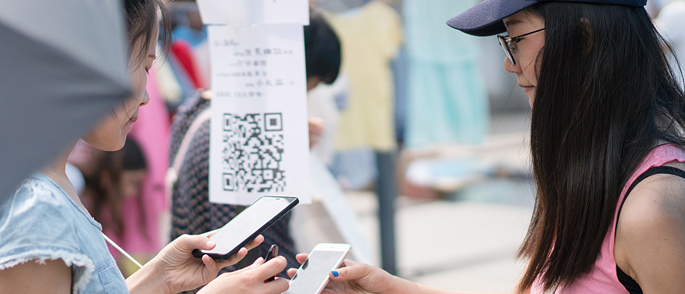
Users scan a QR code to pay through their mobile phone. The rent is usually 1 yuan (14 cents) for an hour, with a 100 yuan deposit. But besides the rentals, income comes from advertisements on the power bank case and its payment platform.
Users of shared power banks in 2016 reached 32 million in China, according to market research firm iiMedia Research. The firm also estimated the user base will rocket about 225 percent to 104 million in the current year.
It said a dozen companies have entered the sector by investing billions of yuan. They include venture capital companies and internet giants such as Tencent.
Laidian Technology Co Ltd, one of the earliest and biggest power bank rental service providers, told China Daily it has set up 5,000 charging stations in over 130 cities in China by May.
CEO Yuan Bingsong, who runs a traditional battery factory, founded the startup in 2014 and regards it as a new opportunity to drive up his factory's shrinking profits.
The startup managed to break even last April but soon started to lose money again, because more players entered the market. He says he needs to put more money into the operation, so it can expand as quickly as possible.
Allen Zhu, managing director and partner of GSR Ventures, one of the earliest investors in the power bank industry, said he believes it is a very good business because establishment costs can be earned back within two to three months and the need to charge phones is constant.
"But the competition will be even more fierce than in shared-bikes," he told a forum organized by US tech media TechCrunch on June 19 in Shenzhen. He said the winners in the battle would emerge in about half a year.
Zhu said he believed the key to winning was to achieve as much market share as quickly as possible, which needed major capital investment.
Charger startups are striving to grow by opening up in previously untouched markets.
Xiaodian Technology, a shared-power bank startup Zhu invested in, is in discussions with partners to bring the business to foreign markets, including Japan, South Korea and countries in Southeast Asia.
Another player, Jiedian Technology, in May received a 300 million yuan investment from Jumei.com, one of the biggest online beauty production retailers.
Jiedian Technology CEO Yuan Yuan said battery and electric car maker BYD had become its supplier, beefing up power banks from the current 300,000 units to 500,000 units in July.
But risks and concerns remain. The report by iiMedia Research shows only 25 percent of people surveyed use power bank to charge their smartphones.
In addition, information safety is another major concern. Fan Zengyan, an analyst of iiMedia Research, said a shared-power bank can be plugged into hundreds of mobile phones, at a time when phones have become the primary carrier of important personal information.
He warned that if a virus were inserted into the banks, users' personal information and even personal assets could be at risk.
The analyst added that making information safety secure in their phones was a significant question that shared-charging startups needed to answer.
Jiedian Technology's Yuan said his group had placed a safety device within their charging stations.
"If a power bank is opened or modified, it can't be returned to our stations anymore."