China's central bank to walk fine line in multi-tasking operations


 |
|
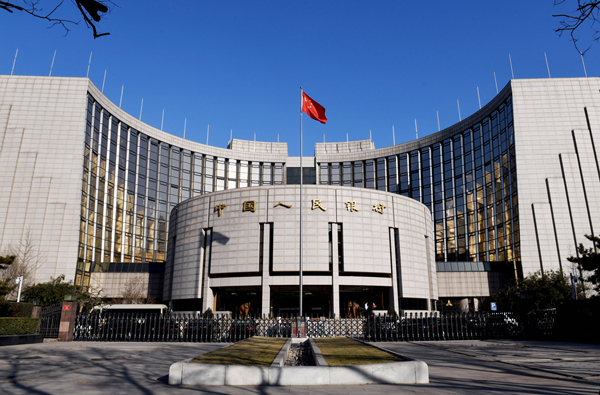
View of the headquarters of the People's Bank of China, China's central bank, in Beijing, Jan 12, 2017. [Photo/VCG] |
BEIJING - As China's central bank has shifted to a prudent and neutral monetary policy, it will likely be more careful in balancing its multiple goals.
On the one hand, the People's Bank of China is trying to contain leverage and reduce speculation in the financial market. On the other, it is trying to help stabilize growth in an economy that is in the midst of painful restructuring and expanding at its slowest pace in 26 years.
The balancing act needed to achieve its goals will be a complicated task for the central bank, according to Zhang Xiaohui, assistant governor of the PBOC.
"China should keep its monetary policy prudent and stable, appropriately expand aggregate demand to avoid an overly-rapid economic slowdown and at the same time refrain from excessive money supply to prevent bubbles," Zhang has said.
China has kept the same prudent monetary policy since 2011. However, in practice it has been slightly eased for a period of time to alleviate pressure from a slowing economy. As the country's economic health continued to improve, policy makers announced that they would maintain "a prudent and neutral" policy in 2017.
Yi Gang, deputy governor of the PBOC, restated Wednesday that China should "maintain the prudent monetary policy, which is in a neutral state. A neutral state is neither tight nor loose."
Analysts have said the shift indicated that China will lean toward monetary tightening should they need to curb any asset bubbles or mitigate financial risks.
Speculation of China's shifting away from a relative easing policy has intensified since May last year, when an "authoritative figure" warned in a "People's Daily" article that China may suffer a "systematic financial crisis" and economic recession should debt not be properly handled.
At the annual Central Economic Work Conference in December, the central leadership pledged to make a priority of preventing financial risks, saying that curbing asset bubbles would be more important in 2017.
Possible monetary tightening in other major economies and rising price pressure in and outside China have sparked talk of tightening in China this year, but analysts expect the central bank to focus tightening on money-market rates rather than raising benchmark interest rates this year.
Even though China's banks extended a record 12.65 trillion yuan ($1.85 trillion) of new yuan-denominated loans in 2016, the central bank has been moving to raise the costs of funding by tightening liquidity in the interbank market.
Money market rates have been edging higher since the third quarter of 2016. In January, the central bank raised rates on its medium-term loan facility for the first time since it debuted in 2014.
The months ahead will see a continuation of cautious, incremental tightening.
"(Which) reflects the need to lean against excess loan growth, support the yuan as the US Fed moves further into its tightening cycle, and head off nascent inflationary pressure," said Tom Orlik, chief Asia Economist at Bloomberg.
Orlik said an increase in benchmark interest rates is possible but not likely given elevated risks to the growth outlook. Continued use of open market operations, targeted instruments, and window guidance appears more likely.
Unlike early last year, when China had a troublesome start, the world's second-largest economy has entered 2017 on a much more solid footing, giving policy makers more room to maneuver.
Exports and imports staged strong rebounds in January, official manufacturing purchasing managers' index remained in expansionary territory for six consecutive months while producer price index (PPI) rising to a five-year high.
Strong PPI rebound and turnaround in Chinese heavy industry have improved corporate revenue, profit growth and debt service capacity, leaving the real economy much better placed to tolerate higher nominal rates, UBS economist Wang Tao said.
However, as China is expected to face persistently weak external demand, ongoing deleveraging and capacity-reduction pressure and a cooling property sector, maintaining stable growth will not be easy in 2017.
The risk of bond yields and money market rates' moving higher has increased in recent weeks, but will unlikely be allowed to reach levels that could jeopardize growth, Wang said.
Wang expected China's credit growth to moderate only gradually to about 14.9 percent this year, down from 16.1 percent in 2016.