Provinces pin high hopes on FTZs


Model becomes engine of economic growth
By ZHONG NAN
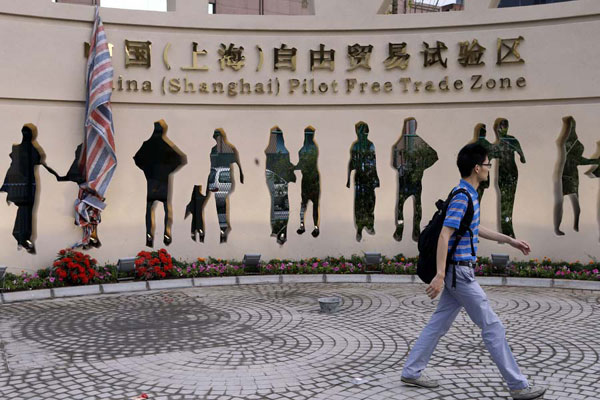
China currently operates four free trade zones, all along its coastline. It established its first pilot FTZ in Shanghai in August 2013, and a second batch in Tianjin, Fujian and Guangdong in 2014.
Vice-Minister of Commerce Wang Shouwen, said China has introduced 19 practical measures tested to be effective in four FTZs, in terms of administrative reforms, investment and policies, to assist innovation and economic growth throughout the country.
"The FTZ model certainly has become a new driving power in the slowing economy. With the addition of the third batch, China is targeting wider reforms to push these regions to explore their industrial and geographical limits," Wang said.
Among the practical trials in the earlier FTZs was the implementation of a "negative list", which specifies investment sectors as off-limits to foreign investors and allows industries not on the list to open to overseas and Chinese companies on equal footing.
The negative-list approach originated in the United States. To date, more than 70 countries and regions have adopted this method to manage foreign investment, and it has become a common measure in investment regulations globally.
The China (Shanghai) Pilot Free Trade Zone has narrowed its negative list to increase transparency in foreign investment management. The 2014 version of the Shanghai FTZ negative list was cut down to 139 sectors, far fewer than the 190 in the 2013 version. The negative list of the four Chinese FTZs covered 122 sectors by first half of 2016, which will be further reduced from long-term run.
Li Guo, deputy head of the General Administration of Customs, said the development of FTZs also provides growth points for many sectors, such as account auditing, financial institutions, share brokerages, fund management, telecommunications, culture and education, which previously weren't allowed to open to foreign businesses.
The expansion of the negative list across the country will make China's talks with the European Union and the US on bilateral investment treaty more fruitful, said Li Gang, vice-president of the Chinese Academy of International Trade and Economic Cooperation.
"BIT talks are based on the negative list and other favorable national treatment," Li said. "It would build better foundations to discuss BIT terms with other partners. The experiences gained by earlier FTZs have set up a useful example for other parts of the country to adopt this approach to boost both trade and investment activities."