Alumni start camp to foster business skills among youth


 |
|
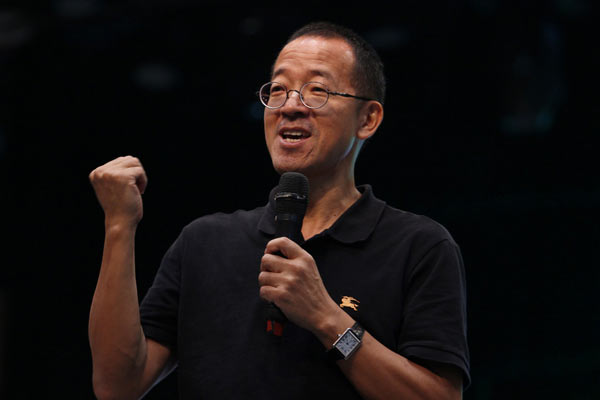
Yu Minhong, famed CEO of New Oriental education, makes speech in China University of Geosciences in Wuhan, capital of Hubei province, on September 23, 2016. [Photo/IC] |
China is building a national entrepreneurship and innovation "ecosystem" to cultivate competitive startups and more innovative entrepreneurs, said Wang Jian, founder and CEO of the Entrepreneur's Training Camp at Peking University.
"The ecosystem will foster innovation and provide opportunities for students, graduates and young professionals to start their own businesses," Wang said.
Before Premier Li Keqiang laid out his plans for a mass entrepreneurship and innovation program in 2014, Wang founded the camp in 2012 and vowed to create a rich entrepreneurial atmosphere on and off campus.
Run by the Peking University's alumni association, the training camp offers hands-on entrepreneurship programs, including tutorials, mentoring with figures from established businesses in China, and, in some cases, access to funding.
"Last year we helped around 11,400 individuals," said Wang.
Starting a business can be difficult for students, as many lack experience, networks and funding, according to Liu Yang, founder of Mars Club, a Beijing-based education startup, and a camp alumnus.
"The camp helped me a lot," said Liu. "I gained knowledge and experience from prominent professionals, who made it easier for me to manage our team and also reach for more resources."
China's push to boost entrepreneurism has added "vitality into our nation's economy," said Wang. "With the support of the government, more actions are on the way to eliminate barriers to entrepreneurship."
According to Wang, mass entrepreneurship and innovation can act as an engine to drive economic growth and integrate the production capacity of China's established industries with new advanced technologies offered by startups.
The latest KPMG analysis shows China had venture capital investments of $31 billion in 2016, up 19 percent year-on-year. However, deal volumes declined 42 percent to 300 from 513 in 2015, it said.
"This year will be better," Wang said. "The more rational the entrepreneurs are, the more money investors dare to pour into the market."
- Optimizing the Environmental Policy for the Promotion of Mass Entrepreneurship and Innovation
- Research center all set to explore entrepreneurship in G20 countries
- Entrepreneurship gains popularity in Shanghai schools
- Pingtan holds innovation and entrepreneurship salon
- Haidian to upgrade innovation and entrepreneurship