BEIJING - China's ambition to advance reform and maintain medium to high growth has injected hope and stability into the world economy, experts have observed.
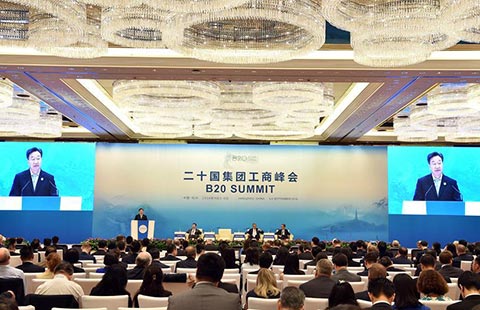
Addressing the opening ceremony of the Business 20 summit in Hangzhou, Chinese President Xi Jinping reassured the world's business leaders that China can realize strong growth and would not backslide on structural reform and opening up.
Xi told the business leaders that China has the confidence and ability to maintain medium to high growth and deliver development opportunities to the world while ensuring its own development.
Xi's remarks assured the world that China has the confidence of maintaining strong growth through advancing reform, which will contribute more to global economic growth, said Jia Jinjing, a researcher with the Chongyang Institute for Financial Studies of the Renmin University of China.
Rapid growth over the past few decades has seen China become the world's second-largest economy, benefiting not just China but countries throughout the world.
However, the export-driven and investment-led growth model that once propelled development has reached its limits. Emerging problems such as industrial overcapacity, high debt levels, pollution and sluggish global demand, all weigh on growth.
Fully aware of the bottleneck in the old growth model, China is turning to innovation-driven development characterized by a green economy, opening up and sharing, all of which are a powerful support and guarantee for good growth, said Zhang Zhanbin from the Chinese Academy of Governance.
Indeed, instead of making any radical stimulus moves China has resorted to supply-side structural reform to optimize its economic structure, cut industrial overcapacity, slash costs and boost efficiency.
Such efforts are painful and take time but positive results are beginning to take shape.
The economy is now more balanced and driven more by consumption than investment. Consumption contributed to over 73 percent of China's economic growth in the first half of this year, up 13.2 percentage points year on year.
Torpid state-owned firms are undergoing modernization, coal and steel companies are slashing capacity and the government is ceding more power to the market.
The number of free trade zones has rapidly expanded. Foreign companies are reaping benefits in China, and the country is considering allowing them easier access to the market.
China's story proves that though structural reform is difficult, it is rewarding. The leadership is unswerving in its resolve to press ahead with reforms, said Xin Ming, a professor with the Party School of the Communist Party of China Central Committee.
Over the course of the 27 meetings convened by the Central Leading Group for Deepening Overall Reform since December 2013, hundreds of measures have been implemented to address various issues, including urbanization, poverty alleviation and the market's role in resource allocation.
Accordingly, China can share its experience in managing transition to encourage and help other countries to achieve mutually beneficial cooperation and promote global economic integration, said Zhang Liqun, a researcher with the State Council's Development Research Center.
Eight years after the global financial crisis, the recovery remains slow and fragile. Current global growth is mediocre at best, featuring rising unemployment, soaring debt, sluggish trade and investment, and turbulent financial and commodity markets.
For China's economy, the transition to a service and consumption-driven economy, accompanied by an improved social security system, will unleash huge demand and business opportunities.
China's desire to upgrade its manufacturing sector means lucrative business opportunities for multinationals. Foreign investment in high-tech services in China from January to June nearly doubled over the previous year.
Foreign multinationals have made huge profits in cooperation with Chinese firms in new materials, new-energy vehicles, aircraft components, integrated circuits, old-age care and cloud computing.
In the meantime, China's export of production infrastructure and domestic companies going global have benefited foreign businesses.
Chinese enterprises invested 88.9 billion U.S. dollars in 155 countries and regions from January to June this year, surging 58.7 percent year on year. They created local jobs and helped upgrade local industries.
Stephen S. Roach, a senior fellow at Yale University's Jackson Institute of Global Affairs, estimated in late August that China could contribute to nearly 39 percent of the world's economic growth this year.
All that said, major economies worldwide have seen hope in China's economic growth, which is promising and bringing new impetus to the world economy, said Xu Guangjian, deputy director of the School of Public Administration and Policy at the Renmin University of China.


Copyright 1995 - . All rights reserved. The content (including but not limited to text, photo, multimedia information, etc) published in this site belongs to China Daily Information Co (CDIC). Without written authorization from CDIC, such content shall not be republished or used in any form. Note: Browsers with 1024*768 or higher resolution are suggested for this site.
License for publishing multimedia online 0108263 Registration Number: 130349