 |
|
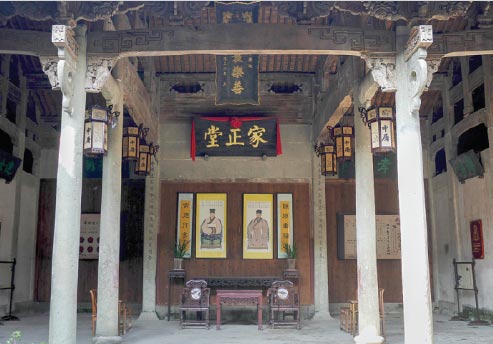
The ancestral hall of the Shentu family in Dipu village. [Photo provided to China Daily] |
Over 70 percent of Dipu's villagers share the surname Shentu and regularly visit their ancestral hall.
A local man built the nearby Baoqing Theater in the Ming Dynasty (1368-1644) to show gratitude for his uncle, who raised him.
The wooden platform, adorned with such ornately carved auspicious symbols as lions, crayfish and bats, still serves his descendants as a stage for reverence of family ties.
A stele marking the tomb of the first settler in the middle of a roundabout on Dipu's main road again places filial piety front and center, in every sense.
Indeed, a visit to Dipu makes you want to visit your parents afterward. Or at least call home.
Such reverence for forbearers extends to neighboring Huanxi village, where 90 percent of the 2,000 residents take their surname from the first settler, Zhou Weishan, who built his home in the shade of ancient gingko trees six centuries ago.
The surviving trees lining Gingko Square are today over a millennia old.
But even more venerated is the 14-generation branch of the Zhou family tree that extends from Huanxi's Confucian philosopher Zhou Dunyi, who penned the poem Ode to the Lotus in the Northern Song Dynasty (960-1127)..
Locals learn its lines as children and can recite the prose by heart.
Roughly 334,000 square meters of lotuses bob atop ponds throughout the town. They're not only central to the settlement's history and culture but also to its economy.
Lotus seeds are sold as snacks and pulverized to produce tea and liquor.
And the plants give vim to the scenic splendor that draws tourists who occupy Huanxi's six-dozen bed and breakfasts.
Families process them in their courtyards with hand-crank grinders.
The Lotus Culture Hall takes its namesake from Zhou Dunyi's poem and serves as his ancestral hall, an auditorium and an art gallery.
On residents' 63rd birthdays, relatives release carp into the Tianzi and Qing rivulets that encase three sides of the settlement and join at its main gate to transform into dragons. The symbolism represents longevity in local lore.
Superstition or not, over 300 villagers are older than 60, and the oldest is 103.
That said, the water-dwelling creatures are traditionally believed to have brought the floods that led to the construction of two ancient bridges, including the Crocodile Bridge-so named because the reptile is considered the mythological deities' natural nemesis.
Today, Crocodile Bridge serves as a link between Tonglu's past and present, and connects Huanxi to the outside through tourism, in a very real sense.


Copyright 1995 - . All rights reserved. The content (including but not limited to text, photo, multimedia information, etc) published in this site belongs to China Daily Information Co (CDIC). Without written authorization from CDIC, such content shall not be republished or used in any form. Note: Browsers with 1024*768 or higher resolution are suggested for this site.
License for publishing multimedia online 0108263 Registration Number: 130349