 |
|
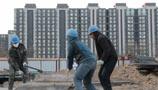
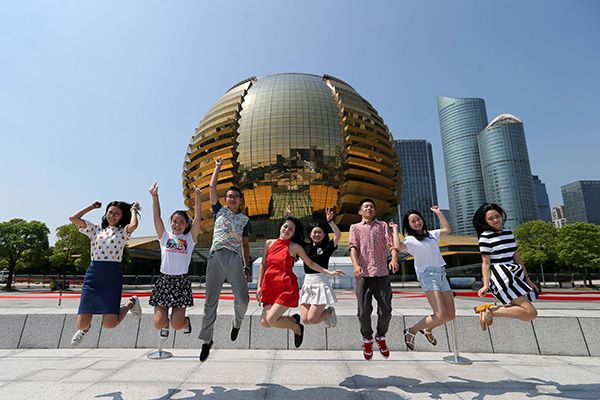
Young volunteers who are assisting the B20 Summit jump together in front of the event's main venue in Hangzhou, Zhejiang province. WANG ZHUANGFEI / CHINA DAILY |
Business 20 pushing for G20 to adopt and implement practical measures to advance trade, investment and innovation
As the world looks to emerge from the shadow of the global financial crisis that erupted eight years ago, President Xi Jinping's speeches at the upcoming G20 Leaders Summit and the B20 Summit in Hangzhou are expected to propose long-term governance mechanisms and a number of new measures to promote trade, investment and innovation, said officials and business leaders of the B20.
The B20 summit and meetings involve representatives of the international business community who offer advice to the G20 leaders.
They have proposed a number of first-time proposals including building a global e-commerce platform and a joint fund to develop advanced technologies, as well as visa-free policies for managers of small and medium-sized enterprises to travel within the group.
Yi Huiman, chairman of the Industrial and Commercial Bank of China and a member of the B20's financing growth taskforce, said as the G20 accounts for 85 percent of the world's economy, 80 percent of world trade and outbound investment and 70 percent of inbound investment, the speech of the president was expected to encourage support for trade and finance to help contribute to global growth.
The G20 started off as a forum featuring regular meetings of the finance ministers and central bank governors of the world's major economies. It was remodeled into a summit for the leaders of the 19 largest economies and the European Union in the aftermath of the 2008 financial crisis.
However, in the post-crisis era, the G20 has met new challenges, and it has been urged to shift its focus from crisis management to long-term governance.
"In the current global economic climate, the G20 needs to structurally upgrade itself to help the global economy get out of the low growth trap," said Ren Hongbin, president of China National Machinery Industry Corp.
Liang Guoyong, an economic affairs official at the United Nations Conference on Trade and Development, said China's implementation of measures to address its economic issues reflects the country's efforts to improve global economic governance and promoting its prominence on the global stage.
Pierre Nanterme, CEO of Accenture Plc, a global consulting and professional services company, said he is a strong believer that e-commerce and related trade methods will be the main engines for global economic growth, as well as offering smaller companies more access to foreign markets.
"That is why in the B20's SME development taskforce, we are strongly supporting the creation of a platform called the Electronic World Trade Platform," Nanterme said.
The Asia-Pacific Economic Cooperation, a forum for 21 Pacific Rim economies, has already reached a consensus with members of the G20 that cross-border e-trade would be one of the best ways of enabling SMEs to address the obstacles they face in accessing foreign markets.
Phil O'Reilly, director of business consultancy Iron Duke Partners in New Zealand, predicted that the Chinese leader's speech will emphasize the developing e-trade to further accelerate the pace of global trade pace and necessary infrastructure development.
"It is enormous growth potential, not just e-commerce in China across borders, but in every country," he said. "It would mean that small and medium-sized businesses could be global from day one. It is not just trading out of China or trading into China-it is doing trade anywhere in the world."
In its latest prediction, the International Monetary Fund has lowered this year's global economic growth target from 3.1 percent to 2.9 percent.
If the projections turn out to be true, 2016 will be the second consecutive year of less-than-3-percent global growth after last year's 2.4 percent.
In addition, the developed economies are facing weak recoveries. Earlier this year, the IMF downgraded its economic growth forecasts for the United States, the EU and Japan.
Aging populations, wealth distribution inequality, technological monopolies, trade protectionism, the Syria refugee crisis and terrorism are believed to be the main reasons behind the low-growth. To tackle these problems, the G20 members need to increase their inputs into promoting sustainable development.
"That is why the upcoming G20 Summit has, for the first time, chosen to put development at the top of the macro-policy agenda, and will put forward an action plan for implementing the United Nation's 2030 Agenda for Sustainable Development," said Wang Shouwen, vice-minister of commerce.
It is also why China considers the lack of growth impetus to be a key issue for this year's summit and has put forward a blueprint for innovation-driven growth, Wang said.
China currently is trying to stimulate growth by focusing on the supply-side reform. Its efforts in this endeavor can be of great benefit for the countries worldwide that are striving to get their sluggish economies back on track.
The supply-side structural reform is aimed at cutting low-end industrial capacity while increasing high-tech production.
"Eager to enhance the world's trading ability, China will push for the adoption of a global trade growth strategy at the summit, lay out guiding principles for global investment policies and promote deepening reform of the existing international financial system," said Xu Hongcai, director of the Economic Research Department at the China Center for International Economic Exchanges.
About B20
The Business 20 is a key platform for the international business community to participate in global economic governance and international economic and trade regulation.
Centered on the B20 taskforce meetings and the B20 summit, it supports the work of the G20 by hosting focused policy discussions and developing recommendations geared toward strong, sustainable and balanced growth in the global economy.
Over the years the B20 priorities have been clearly aligned with those of the G20 Summit, focusing on major goals in global economic development.
These include reform of the financial system, trade, investment, infrastructure, employment and anti-corruption measures.
The B20 taskforces consult with the business community and devise a list of recommendations for G20 members.
Since 2010 more than 400 policy recommendations have been proposed. These continue to be highly valued by G20 leaders, and many have been incorporated into previous G20 communiqués.
Many G20 leaders have attended previous B20 summits and exchanged views with B20 delegates.


Copyright 1995 - . All rights reserved. The content (including but not limited to text, photo, multimedia information, etc) published in this site belongs to China Daily Information Co (CDIC). Without written authorization from CDIC, such content shall not be republished or used in any form. Note: Browsers with 1024*768 or higher resolution are suggested for this site.
License for publishing multimedia online 0108263 Registration Number: 130349