 |
|
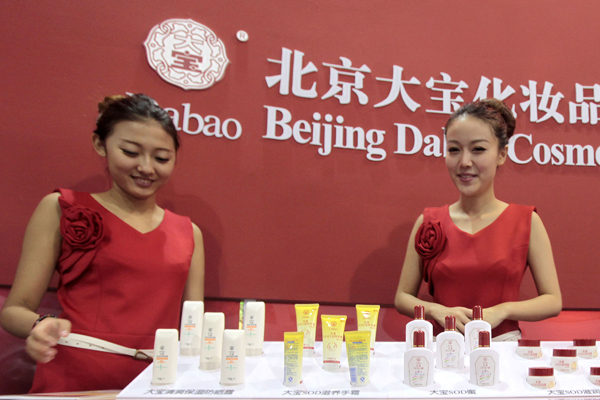
The stand of Beijng Dabao Cosmetics Co Ltd at an industry expo in Beijing.[Photo provided to China Daily] |
China's skincare and make-up sectors registered strong growth of 12 and 10 percent respectively last year with South Korean and Japanese brands making up the lion's share of the increase, according to an industry report.
The ratio is higher than the overall growth of 3.1 percent in the fast moving consumer goods sector, according to latest figures published by Kantar Worldpanel, indicating that the cosmetics sector remains an important growth engine of China's FMCG market.
"Chinese consumers are becoming more sophisticated, and are opting to buy more premium products which are fueling the value growth of these sectors. This presents brand-new opportunities for both international and domestic players," said Jason Yu, general manager of Kantar Worldpanel China.
Dabao, a brand acquired by Johnson & Johnson, leads Kantar's 2016 Cosmetic Brand Footprint ranking, which measures which brands are being bought most often by the most consumers.
Daobao products were chosen by 23.1 percent of the population, on average twice a year.
Pechoin occupies second place and was the fastest riser in terms of consumer touch points, adding more than 3.6 million families to its brand over the last 12 months.
The double-digit growth of the cosmetic sector was mostly driven by trading up, which accounted for 82 percent of market growth, said the report.
Despite strong growth in the cosmetics market, the competitive landscape in China also went through rapid transformation, the report said.
Among all the 4,000 brands tracked by Kantar Worldpanel, only 40 percent of them saw an increase in net sales.
Among the top 20 growing brands in the market, a rise in penetration accounted for 78 percent of their collective growth, proving that the continual recruitment of shoppers is the key way to grow sales.
Aside from Pechoin, Hans, Innisfree, Dr. Morita and Shiseido also managed to grow their consumer reach faster than the other players.
South Korean Amorepacific Group Inc, which owns brands including Innisfree, had its revenue in China grown from 464 billion South Korean won ($0.42 billion) in 2014 to 765 billion South Korean won in 2015, according to its annual financial report for the year ended Dec 31, 2015.
Yu said: "Consumers today have unprecedented choices available to them thanks to overseas travel and e-commerce, yet the growth of Chinese brands and South Korean/Japanese brands is noticeable.
"While consumers are more ready to trade up, those brands which advocate health, efficacy and fun are winning consumers' choices, on the back of unique product and marketing innovation as well as smart Omni-Channel deployment. "
The report also found out that consumers are embracing natural and safe product concepts. Successful brands differentiate themselves by advocating new concepts, benefits and usage occasions, as well as pure and natural ingredients.


Copyright 1995 - . All rights reserved. The content (including but not limited to text, photo, multimedia information, etc) published in this site belongs to China Daily Information Co (CDIC). Without written authorization from CDIC, such content shall not be republished or used in any form. Note: Browsers with 1024*768 or higher resolution are suggested for this site.
License for publishing multimedia online 0108263 Registration Number: 130349