 |
|
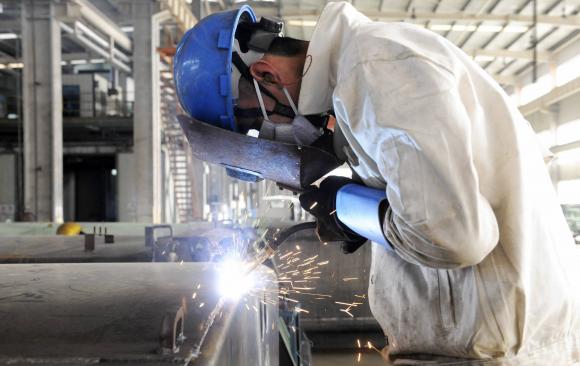
An employee welds the exterior of a vehicle along a production line at a factory in Qingdao, Shandong province on Dec 1, 2014. [Photo/Agencies] |
BEIJING - China's regional economies grew stably in the first half (H1) of 2016, but were marked by performance divergence, said the National Development and Reform Commission (NDRC), the top economic planner.
The underdeveloped western region posted the fastest growth rate of 8 percent year on year, well above the national average of 6.7 percent; the central and east regions grew by 7.8 percent and 7.6 percent respectively; while the northeast rust belt increased by 2.2 percent, said the NDRC.
Meanwhile, fixed asset investment and industrial value-added output in the west region expanded by 13.5 percent and 7.2 percent.
In the first six months, Chongqing and Tibet in the west led the growth at the provincial level, both posted growth speed of 10.6 percent.
In sharp contrast, the northeastern steel-making province of Liaoning saw its economy shrink by 1 percent in the first half of 2016 from the same period last year, the only province to report a contraction.
Liaoning was one of the last of China's 31 provincial regions to announce its gross domestic product (GDP) data. Figures are yet to be published by highly industrialized Heilongjiang in the northeast.
The provincial growth imbalance came as China tries to restructure its economy from one that is export driven to consumer driven.
China's economy grew 6.7 percent year on year in Q2, aided by infrastructure investment, a housing boom and bank lending. Although the growth rate is the country's slowest quarterly growth since the first quarter of 2009, it remains within the government's target range of 6.5-7 percent for 2016.
To bolster economic growth, the top economic planner has suggested more policy tools to boost private investment rather than relying on government spending.
The private sector will be important to supporting economic growth, generating about 60 percent of China's GDP and around 80 percent of jobs.
However, private investment has been slowing. It increased by only 2.8 percent in H1, down from 3.9 percent in the first five months of the year.


Copyright 1995 - . All rights reserved. The content (including but not limited to text, photo, multimedia information, etc) published in this site belongs to China Daily Information Co (CDIC). Without written authorization from CDIC, such content shall not be republished or used in any form. Note: Browsers with 1024*768 or higher resolution are suggested for this site.
License for publishing multimedia online 0108263 Registration Number: 130349